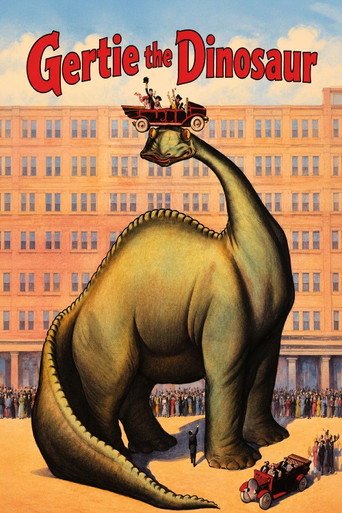
Gertie the Dinosaur (1914)
Although not the first feature-length animated film, as is sometimes thought, it was the first cartoon to feature a character with an appealing personality. The appearance of a true character distinguished it from earlier animated "trick films", such as those of Blackton and Cohl, and makes it the predecessor to later popular cartoons such as those by Walt Disney. The film was also the first to be created using keyframe animation.
- Data lansării
- 1914-02-08
- TMDB
- 6.7 / 10 (160)
- Durată
- 12 min
- Genuri
- Animaţie, Comedie
- Regizor
- Winsor McCay
Distribuție
- Winsor McCay — Self
- George McManus — Self
- Roy L. McCardell — Self
- Thomas A. 'Tad' Dorgan — Thomas A. 'Tad' Dorgan
- Tom Powers — Clumsy Copy Boy (uncredited)
- Robert McCay — Self
- John Bunny — Club Member
Curiozități
Gertie the Dinosaur is an animated short film released in 1914 by American cartoonist and animator Winsor McCay. It is the first animated film to feature a dinosaur. McCay initially presented the film before live audiences as an interactive part of his vaudeville act; the frisky, childlike Gertie performed tricks at her master's command. McCay's employer William Randolph Hearst curtailed his vaudeville activities, prompting McCay to add a live-action introductory sequence to the film for its theatrical release, which was renamed Winsor McCay, the Famous Cartoonist, and Gertie. McCay abandoned a sequel, Gertie on Tour, after producing about a minute of footage.
Production
Gertie was McCay's first piece of animation with detailed backgrounds. Main production began in mid-1913. Working in his spare time, McCay drew thousands of frames of Gertie on 6+1⁄2-by-8+1⁄2-inch (17 cm × 22 cm) sheets of mulberry paper, a medium good for drawing as it did not absorb ink. Since it was translucent, it was also ideal for the laborious retracing of backgrounds, a job that fell to art student neighbor John A. Fitzsimmons.
McCay was concerned with accurate timing and motion; he timed his own breathing to determine the timing of Gertie's breathing, and included subtle details such as the ground sagging beneath Gertie's weight. McCay consulted with New York museum staff to ensure the accuracy of Gertie's movements; the staff were unable to help him find out how an extinct animal would stand up from a lying position, so in a scene in which Gertie stood up, McCay had a…
McCay pioneered the "McCay Split System" of animation, in which major poses or positions were drawn first and the intervening frames drawn after. This relieved tedium and improved the timing of the film's actions. McCay was open about the techniques that he developed, and refused to patent his system, reportedly saying: "Any idiot that wants to make a couple of thousand drawings for a hundred feet of film is welcome to join the club." During prod…
Citește pe Wikipedia · Text din Wikipedia, CC BY-SA 4.0. Date din Wikidata.
Recomandate
- Puss Gets the Boot 1940 · ★ 7.0
- Bone Trouble 1940 · ★ 6.9
- Mickey's Steam Roller 1934 · ★ 6.4
- The Ugly Duckling 1939 · ★ 7.0
- The Wise Little Hen 1934 · ★ 6.6
- Clown of the Jungle 1947 · ★ 6.4
- Mickey's Kangaroo 1935 · ★ 5.9
- Pixar Short Films Collection: Volume 1 2007 · ★ 7.9
- Super Rhino 2009 · ★ 5.9
- Baseball Bugs 1946 · ★ 6.9
- Old MacDonald Duck 1941 · ★ 6.2
- The Flying Cat 1952 · ★ 6.9