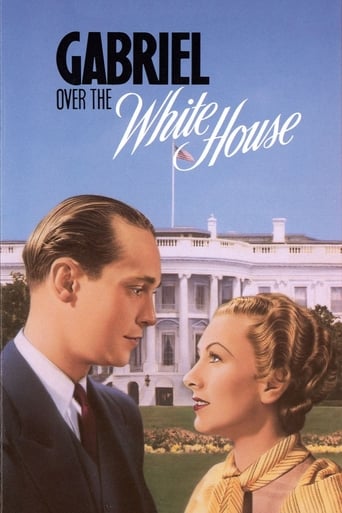
Gabriel Over the White House (1933)
The sensation of a nation!
A political hack becomes President during the height of the Depression and undergoes a metamorphosis into an incorruptible statesman after a near-fatal accident.
- Date of release
- 1933-03-31
- TMDB
- 6.8 / 10 (15)
- Runtime
- 1h 26m
- Genres
- Drama, Fantasy, Romance
- Director
- Gregory La Cava
Casting
- Walter Huston — Hon. Judson Hammond - The President of the United States
- Karen Morley — Pendola Molloy
- Franchot Tone — Hartley Beekman - Secretary to the President
- Arthur Byron — Jasper Brooks - Secretary of State
- Dickie Moore — Jimmy Vetter
- C. Henry Gordon — Nick Diamond
- David Landau — John Bronson
- Samuel S. Hinds — Dr. H.L. Eastman
- William Pawley — Borell
- Jean Parker — Alice Bronson
- Claire Du Brey — Nurse
- B.F. Blinn — Politician (uncredited)
Interesting facts
Gabriel Over the White House is a 1933 American pre-Code political fantasy film starring Walter Huston as a genial but politically corrupt U.S. President who has a near-fatal automobile accident and comes under divine influence—specifically that of the archangel Gabriel. Eventually, he takes control of the government, solves the problems of the nation, from unemployment to racketeering, and arranges for worldwide peace, before the angel leaves him, and he dies.
Production
Production began in February 1932. Gabriel over the White House was released on March 31, 1933, with a run time of 85 to 87 minutes. A review print screened by Daily Variety on December 31, 1932, ran for 102 minutes, indicating that as many as 17 minutes were cut.
Walter Huston had recently portrayed Lincoln in the 1930 biographical film Abraham Lincoln, which was adapted for the screen by Stephen Vincent Benét, author of the epic poem John Brown's Body, winner of a 1929 Pulitzer Prize. Huston's performance in the film was highly praised, in spite of the fact that the cosmetics used to make him look younger in the scenes of Lincoln's youth had a comical effect.
According to Turner Classic Movies, modern sources have uncovered the fact that Louis B. Mayer did not see the script before filming and, as a staunch Republican and supporter of Herbert Hoover, held the film back until after the inauguration of President Roosevelt on March 4.
In a 2013 article in The New Yorker, Richard Brody wrote that "The story is extraordinary—and so is the story of its production, as told in Matthew Bernstein's biography of its producer, Walter Wanger, who gave the project its impetus. Hammond is a wild man with a purpose—and the new U.S. President, Franklin D. Roosevelt, loved it. As Bernstein tells it, this was no surprise; the movie was conceived as a Rooseveltian vehicle from the start.
"Wanger was working under the aegis of the production company owned by William Randolph Hearst, an ardent Roosevelt supporter (and who had much to do with Roosevelt securing the Democratic nomination) whose films were distributed by M-G-M, the boss of which, Louis B. Mayer, was a rock-ribbed Republican. Though Mayer was appalled, he didn't block its release (on March 31).
Read on Wikipedia · Text from Wikipedia, CC BY-SA 4.0. Data from Wikidata.
Recommended
- Bad Girl 1931 · ★ 6.0
- Christmas Cottage 2008 · ★ 6.3
- Flamingo Road 1949 · ★ 7.0
- Strange Cargo 1940 · ★ 7.0
- Peter Ibbetson 1935 · ★ 7.0
- Donovan's Echo 2011 · ★ 6.0
- The Secret: Dare to Dream 2020 · ★ 7.4
- Autumn Leaves 1956 · ★ 7.0
- How Sarah Got Her Wings 2015 · ★ 5.9
- Nobody Has to Know 2022 · ★ 6.7
- The Lost Husband 2020 · ★ 6.6
- The Vanishing of Sidney Hall 2018 · ★ 6.7