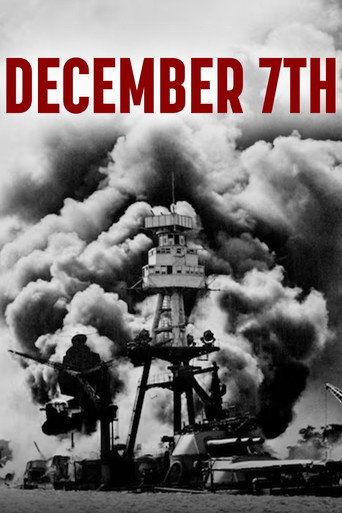
December 7th (1943)
"Docudrama" about the bombing of Pearl Harbor on December 7th, 1941 and its results, the recovering of the ships, the improving of defense in Hawaii and the US efforts to beat back the Japanese reinforcements.
- Date of release
- 1943-03-01
- TMDB
- 5.8 / 10 (28)
- Runtime
- 32m
- Genres
- History, War, Action, Documentary
- Director
- John Ford, Gregg Toland
Casting
- Walter Huston — Uncle Sam 'U.S.'
- Harry Davenport — Mr. 'C'
- Dana Andrews — Ghost of US sailor killed at Pearl Harbor
- Paul Hurst — World War I Ghost Soldier
- George O'Brien — Single Voice of the Dead Servicemen (voice)
- James Kevin McGuinness — Narrator (voice)
- Philip Ahn — Shinto Priest (uncredited)
- Addie Allen — Self (uncredited)
- Ralph Byrd — Reporter (uncredited)
- James Conaty — Wounded Officer (uncredited)
- Emperor Hirohito of Japan — Self (archive footage) (uncredited)
- Adolf Hitler — Self (archive footage) (uncredited)
Interesting facts
- Awards: 1 · Nominations: 1. Including: Academy Award for Best Documentary (Short Subject)
December 7th is a 1943 propaganda documentary film produced by the US Navy and directed by Gregg Toland and John Ford, about the December 7, 1941 attack on Pearl Harbor, the event which sparked the Pacific War and American involvement in World War II. Toland was also the film's cinematographer and co-writer. The original version of this film, with a running time of 82 minutes, was not released but was retained by the National Archives. An edited version of 32 minutes length, which removed a long introductory segment and a shorter epilogue, was given limited release to specific audiences but won the Academy Award for Best Documentary in 1944.
Development and censorship
John Ford had been an established director in Hollywood for years, when in 1934 he was commissioned as an officer in the U.S. Naval Reserve. By 1939 he had established the Navy's Field Photographic Branch, which would eventually become a unit under the control of the Office of Coordinator of Information (OCI).
in early 1942, with the U.S. now actively engaged in World War II, both Secretary of War Stimson and Secretary of the Navy Knox had called for a film about the attack on Pearl Harbor and its immediate aftermath, each suggesting a three-part structure dealing with conditions in Hawaii before the attack, depictions of the attack itself, and the resulting American response.
Because of the surprise nature of the Japanese attack, there was not a great deal of actual documentary footage that could be used for the film project. Toland and his crew returned to Twentieth Century Fox studios in Hollywood in July 1942 and continued to shoot additional scenes and edit the film until February 1943.
In October 1942, despite objections from Donovan and others, Navy Undersecretary James Forrestall invited Lowell Mellett, head of the Bureau of Motion Pictures in the Office of War Information (OWI) to review an early rough cut of December 7th. Mellett recommended against release of the film, arguing that such an important factual event should not be presented as what was largely a work of fiction.
Ford and Toland began revising the completed film in March 1943. In consultation with screenwriter James McGuinness and editor Robert Parrish, Toland and Ford eliminated the fictional prologue and epilogue and made some adjustments to the depiction of the attack and its immediate aftermath, resulting by May in the 32 minute version. Even so, Mellett and others continued to object to wide release of the film.
Read on Wikipedia · Text from Wikipedia, CC BY-SA 4.0. Data from Wikidata.
Recommended
- Why We Fight: Prelude to War 1942 · ★ 6.4
- Let There Be Light 1946 · ★ 7.3
- Father Soldier Son 2020 · ★ 6.5
- WWII From Space 2012 · ★ 7.4
- The Battle of San Pietro 1945 · ★ 6.1
- They Shall Not Grow Old 2018 · ★ 7.8
- The Battle of Midway 1942 · ★ 5.9
- 2000 Meters to Andriivka 2025 · ★ 8.1
- Titanic: 20 Years Later with James Cameron 2017 · ★ 6.6
- 9/11: Inside the President's War Room 2021 · ★ 6.9
- The Soviet Story 2008 · ★ 7.3
- 20 Days in Mariupol 2023 · ★ 8.1