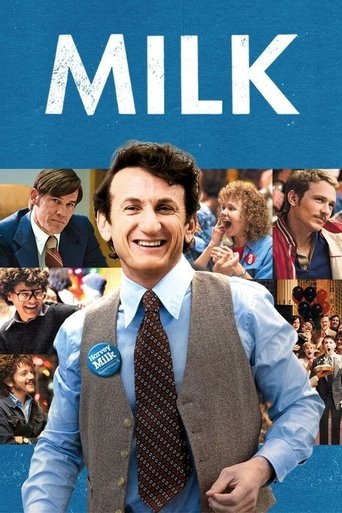
Milk (2008)
Never blend in.
The true story of Harvey Milk, the first openly gay man ever elected to public office. In San Francisco in the late 1970s, Harvey Milk becomes an activist for gay rights and inspires others to join him in his fight for equal rights that should be available to all Americans.
- Date of release
- 2008-11-05
- TMDB
- 7.2 / 10 (2536)
- Runtime
- 2h 8m
- Genres
- History, Drama
- Director
- Gus Van Sant
Casting
- Sean Penn — Harvey Milk
- Emile Hirsch — Cleve Jones
- Josh Brolin — Dan White
- Diego Luna — Jack Lira
- James Franco — Scott Smith
- Alison Pill — Anne Kronenberg
- Victor Garber — Mayor Moscone
- Denis O'Hare — John Briggs
- Joseph Cross — Dick Pabich
- Stephen Spinella — Rick Stokes
- Boyd Holbrook — Denton Smith
- Lucas Grabeel — Danny Nicoletta
Interesting facts
- Filmed in: San Francisco and 1 more
- Awards: 4 · Nominations: 8. Including: Academy Award for Best Actor; Academy Award for Best Writing, Original Screenplay; National Board of Review: Top Ten Films; Producers Guild Stanley Kramer Award
Milk is a 2008 American biographical film based on the life of gay rights activist and politician Harvey Milk, who was the first openly gay man to be elected to public office in California, as a member of the San Francisco Board of Supervisors. Directed by Gus Van Sant and written by Dustin Lance Black, the film stars Sean Penn as Milk, alongside Emile Hirsch, Josh Brolin, Diego Luna, and James Franco.
Production
In early 1991, Oliver Stone was planning to produce, but not direct, a film on Milk's life; he wrote a script for the film, called The Mayor of Castro Street. In July 1992, director Gus Van Sant was signed with Warner Bros. to direct the biopic with actor Robin Williams in the lead role. By April 1993, Van Sant parted ways with the studio, citing creative differences.
In April 2007, the director sought to direct the biopic based on a script by Dustin Lance Black, while at the same time, director Bryan Singer was developing The Mayor of Castro Street, which had been in development hell. By the following September, Sean Penn was attached to play Harvey Milk and Matt Damon was attached to play Milk's assassin, Dan White. Damon pulled out later in September due to scheduling conflicts.
Milk began filming on location in San Francisco in January 2008. The production design and costume design crew for the film researched the history of the city's gay community in the archives of the GLBT Historical Society in San Francisco, where they spent several weeks reviewing photographs, film and video, newspapers, historic textiles and ephemera, as well as the personal belongings of Harvey Milk, which were donated to the institution by the…
The filmmakers also revisited the location of Milk's camera shop on Castro Street and dressed the street to match the film's 1970s setting. The camera shop, which had become a gift shop, was bought out by the filmmakers for a couple of months to use in production. Production on Castro Street also revitalized the Castro Theatre, whose facade was repainted and whose neon marquee was redone.
The film offers special thanks to The Times of Harvey Milk for "its enormous contribution to the making of this movie", and to its director and producer, Rob Epstein.
Read on Wikipedia · Text from Wikipedia, CC BY-SA 4.0. Data from Wikidata.
Recommended
- The Best Man 1964 · ★ 7.3
- Any Day Now 2012 · ★ 7.0
- Hammett 1982 · ★ 6.2
- I Am Woman 2020 · ★ 6.2
- All the Way 2016 · ★ 6.7
- Boy Erased 2018 · ★ 7.0
- Ford v Ferrari 2019 · ★ 8.0
- Blue Moon 2025 · ★ 6.7
- JOY 2024 · ★ 6.9
- The Banker 2020 · ★ 7.6
- Shirley 2024 · ★ 6.6
- Nixon 1995 · ★ 6.8