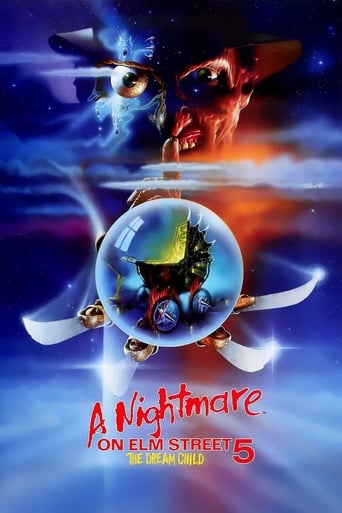
A Nightmare on Elm Street: The Dream Child (1989)
Freddy delivers.
The pregnant Alice finds Freddy Krueger striking through the sleeping mind of her unborn child, hoping to be reborn into the real world.
- Date of release
- 1989-08-11
- TMDB
- 5.4 / 10 (1526)
- Runtime
- 1h 29m
- Genres
- Horror, Thriller
- Director
- Stephen Hopkins
- Collection
- A Nightmare on Elm Street Collection
Casting
- Lisa Wilcox — Alice Johnson
- Robert Englund — Freddy Krueger
- Danny Hassel — Dan Jordan
- Kelly Jo Minter — Yvonne Miller
- Erika Anderson — Greta Gibson
- Nicholas Mele — Dennis Johnson
- Valorie Armstrong — Mrs. Jordan
- Michael Ashton — Gurney Orderly
- Joe Seely — Mark Gray
- Burr DeBenning — Mr. Jordan
- Clarence Felder — Mr. Gray
- Beatrice Boepple — Amanda Krueger
Interesting facts
- Box office: $22.2M
- Budget: $8M
- Earned 2.8× its budget
- Awards: 1 · Nominations: 2. Including: Golden Raspberry Award for Worst Original Song
A Nightmare on Elm Street 5: The Dream Child is a 1989 American gothic slasher film directed by Stephen Hopkins and written by Leslie Bohem. It is the sequel to A Nightmare on Elm Street 4: The Dream Master (1988) and the fifth installment in the A Nightmare on Elm Street franchise. It stars Lisa Wilcox, and Robert Englund as Freddy Krueger. The film follows Krueger, using a now pregnant Alice Johnson's baby's dreams to claim new victims.
Production
Following the commercial success of A Nightmare on Elm Street 4: The Dream Master (1988), New Line Cinema began developing a fifth film for release in 1989. Screenwriter Leslie Bohem had previously proposed a story involving Freddy Krueger possessing an unborn child.
The screenplay underwent extensive revisions during pre-production. John Skipp and Craig Spector developed one draft, originally titled The Dream Pool, while Bohem independently wrote another in December 1988. New Line subsequently commissioned further revisions from Bohem, who worked with director Stephen Hopkins before leaving the project because of other commitments. William Wisher Jr. and David J.
The film has a scene where the character Mark Gray is sucked into a comic book; according to Bohem, all the prospective writers had, independently of each other, written a scene where a character goes into a comic book. Screnwriter Larry Wilson had used this idea in a rejected draft for a potential Beetlejuice 2 film and let Bohem have the scene rather than seeing it go to waste completely.
The previous installment, The Dream Master, had been "aimed at the MTV audience" with Freddy appearing as "almost a stand-up comedian", but for its sequel, New Line Cinema decided to go for a darker tone, returning Freddy to the shadows of the first three films.
Hopkins pursued a more Gothic and expressionistic visual approach than the previous films, incorporating elaborate dream environments and surreal architecture. In a 2025 interview for the Development Hell podcast, he reflected on the production's ambitious visual design and the difficulties caused by its compressed schedule.
Read on Wikipedia · Text from Wikipedia, CC BY-SA 4.0. Data from Wikidata.
Recommended
- A Nightmare on Elm Street 4: The Dream Master 1988 · ★ 5.9
- Immaculate 2024 · ★ 6.2
- A Nightmare on Elm Street 3: Dream Warriors 1987 · ★ 6.7
- It's Alive 1974 · ★ 6.0
- A Nightmare on Elm Street 1984 · ★ 7.4
- Wes Craven's New Nightmare 1994 · ★ 6.5
- Silent Hill 2006 · ★ 6.6
- Cobweb 2023 · ★ 6.4
- The Conjuring: The Devil Made Me Do It 2021 · ★ 7.3
- The First Omen 2024 · ★ 6.8
- The Nun 2018 · ★ 5.9
- Halloween Ends 2022 · ★ 6.0