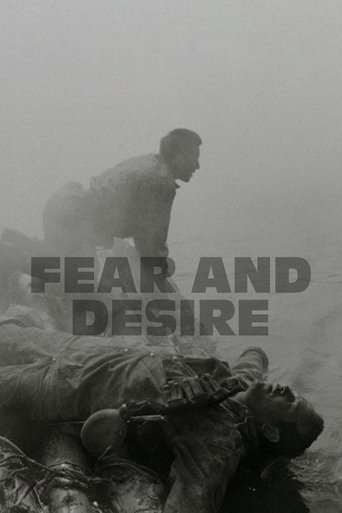
Fear and Desire (1953)
After their airplane crashes behind enemy lines, four soldiers must survive and try to find a way back to their battalion. However, when they come across a local peasant girl the horrors of war quickly become apparent.
- Data lansării
- 1953-03-31
- TMDB
- 5.4 / 10 (567)
- Durată
- 1 h 2 min
- Genuri
- Dramă, Război
- Regizor
- Stanley Kubrick
Distribuție
- Frank Silvera — Mac
- Kenneth Harp — Lt. Corby / The General
- Paul Mazursky — Sidney
- Stephen Coit — Fletcher / The Captain
- Virginia Leith — The Girl
- David Allen — Narrator (voice)
Curiozități
- Filmat în: California
Fear and Desire is a 1952 American independent anti-war film directed, produced, and edited by Stanley Kubrick in his directorial debut, and written by Howard Sackler. With a production team of fifteen people, the film originally premiered at the Venice Film Festival, in a side program, under the title Shape of Fear. Though the film is not about any specific war, it was produced and released at the height of the Korean War. Kubrick famously disowned the film, and spent a large part of his career attempting to block any distribution of it.
Production
Prior to shooting Fear and Desire, Kubrick was a Look photographer who had directed two short documentaries in 1951, Day of the Fight and Flying Padre. Both films were acquired for theatrical release by RKO Radio Pictures. From his experiences in creating short films, Kubrick felt he was ready to make a narrative feature film. Kubrick quit his full-time job with Look and set forth to create Fear and Desire.
The screenplay was written by Howard Sackler, a classmate of Kubrick's at William Howard Taft High School in the Bronx, New York; Sackler later won the Pulitzer Prize for his 1968 drama The Great White Hope. Virginia Leith, who played The Girl in this film, went on to play Jan in the 1962 cult classic The Brain That Wouldn't Die.
Funds for Fear and Desire were raised from Kubrick's family and friends, with most of it coming from Martin Perveler, Kubrick's uncle and the owner of a profitable pharmacy. The film's original budget has been estimated at $10,000.
The production team consisted of 14 people: the director, five actors (Paul Mazursky, Frank Silvera, Kenneth Harp, Steve Coit, and Virginia Leith), five crew members (including Kubrick's first wife, Toba Metz) and three Mexican laborers who transported the film equipment around California's San Gabriel Mountains, where the film was shot. Due to budget limitations, Kubrick improvised in the use of his equipment.
To reduce production costs, Kubrick had intended to make it a silent picture, but in the end the adding of sounds, effects and music brought the production over budget to around $53,000, and had to be bailed out by producer Richard de Rochemont, on condition that he help in de Rochemont's production of a five-part program about Abraham Lincoln for the educational TV series Omnibus, filmed on location in Hodgenville, Kentucky.
Citește pe Wikipedia · Text din Wikipedia, CC BY-SA 4.0. Date din Wikidata.
Recomandate
- Aces High 1976 · ★ 5.9
- Eroii cerului 2006 · ★ 6.5
- Devotion: Eroii aerului 2022 · ★ 7.0
- Memphis Belle 1990 · ★ 6.8
- Curaj sub foc 1996 · ★ 6.6
- Războiul 1994 · ★ 6.7
- Prizioner de război 2025 · ★ 7.0
- Strategic Air Command 1955 · ★ 6.1
- The Purple Plain 1954 · ★ 6.5
- Pearl Harbor 2001 · ★ 6.9
- The Codes of War 2025 · ★ 6.2
- The Boy in the Woods 2023 · ★ 7.0