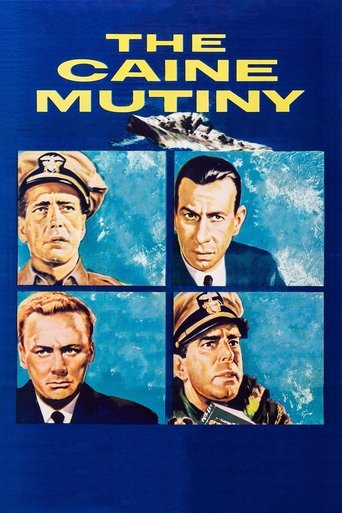
The Caine Mutiny (1954)
As big as the ocean!
When a US Naval captain shows signs of mental instability that jeopardize his ship, the first officer relieves him of command and faces court martial for mutiny.
- Date of release
- 1954-06-24
- TMDB
- 7.3 / 10 (392)
- Runtime
- 2h 4m
- Genres
- Drama, War
- Director
- Edward Dmytryk
Casting
- Humphrey Bogart — Lt. Cmdr. Philip Francis Queeg
- Robert Francis — Ens. Willis Seward 'Willie' Keith
- Van Johnson — Lt. Stephen Maryk
- Fred MacMurray — Lt. Thomas 'Tom' Keefer
- May Wynn — May Wynn
- Katherine Warren — Mrs. Keith
- Jerry Paris — Ens. Barney Harding
- José Ferrer — Lt. Barney Greenwald
- E.G. Marshall — Lt. Comdr. Challee
- Tom Tully — Comdr. DeVriess
- Arthur Franz — Lt. JG H. Paynter Jr.
- Lee Marvin — Meatball
Interesting facts
- Box office: $21.8M
- Budget: $2M
- Earned 10.9× its budget
- Based on: The Caine Mutiny
- Filmed in: California
- Awards: 0 · Nominations: 7
The Caine Mutiny is a 1954 American military trial film directed by Edward Dmytryk, produced by Stanley Kramer, and starring Humphrey Bogart, José Ferrer, Van Johnson, Robert Francis, and Fred MacMurray. It is based on Herman Wouk's Pulitzer Prize-winning 1951 novel of the same name. Set in the Pacific theatre of World War II, the film depicts the events on board a U.S. Navy destroyer-minesweeper and the subsequent court-martial of its executive officer for mutiny.
Production
Principal photography took place between June 3 and August 24, 1953 under the initial working title of Authority and Rebellion.
In addition to the Pearl Harbor and San Francisco Bay Area locations, including the Caine steaming back and forth several times under the Golden Gate Bridge, the romantic subplot features scenes shot on location at Yosemite National Park.
The USS Rodman, a Gleaves-class destroyer minesweeper, was one of the ships chosen to represent the USS Caine in the film. The Rodman had two fewer smokestacks than the actual Clemson-class destroyers on which Wouk served, and had more anti-aircraft guns. Completed in 1941, she was a much more modern ship than the 1918-manufactured Clemson-class destroyer minesweepers had been.
Columbia claimed the film contained the longest continuous courtroom scene without a cut, running to 977 feet, surpassing a scene in The Life of Emile Zola.
The Navy was initially uncomfortable with both the portrayal of a mentally unbalanced man as the captain of one of its ships and the word "mutiny" in the film's title. After Stanley Roberts' shooting script was completed and approved by the Navy after 15 months of negotiations, the Department agreed to cooperate with Columbia Pictures by providing access to its ships, planes, combat boats, Pearl Harbor, the port of San Francisco, and Naval Statio…
Read on Wikipedia · Text from Wikipedia, CC BY-SA 4.0. Data from Wikidata.
Recommended
- USS Indianapolis: Men of Courage 2016 · ★ 5.9
- Billy Budd 1962 · ★ 7.3
- In Enemy Hands 2004 · ★ 5.9
- Stop-Loss 2008 · ★ 6.1
- Thank You for Your Service 2017 · ★ 6.6
- The Thin Red Line 1998 · ★ 7.4
- Billy Lynn's Long Halftime Walk 2016 · ★ 6.0
- Tora! Tora! Tora! 1970 · ★ 7.2
- Mudbound 2017 · ★ 7.3
- One Shot 2021 · ★ 6.7
- Letters from Iwo Jima 2006 · ★ 7.5
- Cherry 2021 · ★ 7.3