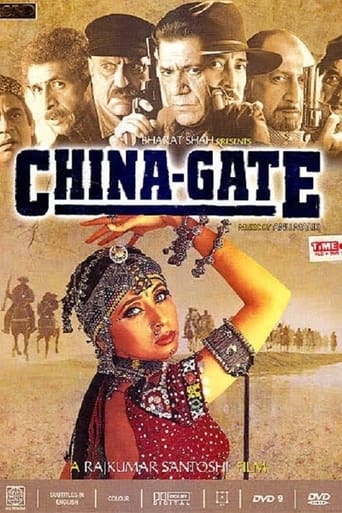
China Gate (1998)
After witnessing the brutal slaying of her Forest Officer father, Sunder Rajan, at the hands of dreaded dacoit Jageera, Sandhya goes to Colonel Krishnakant Puri and asks for his assistance in bringing an end to Jageera's rule in the Devdurg region. Krishnakant agrees to assist her, and summons about a dozen of his fellow officers and subordinates to assist him. They all assemble at Devdurg with all the necessary ammunitions and arms to combat Jageera, not realizing that Jageera has influence over the local police detachment, who will prevent Puri and his men to possess any guns and weapons. This does not deter Puri and his men, and they continue to stay on in Devdurg and gain the confidence of the villagers. What the villagers do not know that Krishnakant and his men had all been dishonorably discharged from the army for cowardice and retreating when attacked by the enemy. Will Puri and his men abandon Devdurg and let history repeat itself?
- 개봉일
- 1998-11-27
- TMDB
- 6.5 / 10 (20)
- 상영 시간(분)
- 2시간 59분
- 장르
- 액션, 모험, 서부
- 감독
- Rajkumar Santoshi
출연진
- Om Puri — Col. Krishnakant Puri
- Naseeruddin Shah — Maj. Sarfaraz Khan
- Danny Denzongpa — Maj. Ranjir Singh Gurung
- Mamta Kulkarni — Sandhya Rajan
- Ila Arun — Mrs. Gopinath
- Kulbhushan Kharbanda — Maj. Kailashnath Gupta
- Paresh Rawal — Inspector Barot
- Tinnu Anand — Capt. Bijon Dasgupta
- Aanjjan Srivastav — Pandey / DK
- Jagdeep — Sub. Nageshwar Rammaiah
- Viju Khote — Ghanshyam
- K.D. Chandran — MD
흥미로운 사실
China Gate is a 1998 Indian Hindi-language revisionist Western action film directed by Rajkumar Santoshi. It was released on 27 November 1998. China Gate follows the basic storyline of the Seven Samurai. The song "Chamma Chamma" picturised on Urmila Matondkar became a chart buster and was used in Baz Luhrmann's film Moulin Rouge!. The film won Filmfare Award for Best Dialogue. The film was moderately successful at the domestic box office especially due to the excellent box office collections in Small Cities, towns and village areas across North India.
Production
The film was conceived as a tribute to Akira Kurosawa's Seven Samurai. The film was made on the budget of ₹20 crores, the most expensive Bollywood production at that point of time.
위키백과에서 더 읽기 · 텍스트 출처: 위키백과, CC BY-SA 4.0. 데이터 출처: Wikidata.
추천
- 결전의 날: 데이 오브 레코닝 2025 · ★ 5.9
- Tall Tale: The Unbelievable Adventure 1995 · ★ 6.2
- 제인 갓 어 건 2015 · ★ 5.9
- 진정한 용기 1969 · ★ 7.3
- 맥켄나의 황금 1969 · ★ 6.6
- 블랙 하이웨이 2025 · ★ 7.5
- 바바로사 1982 · ★ 5.9
- 더 라스트 스탠드 오브 엘런 콜 2024 · ★ 8.1
- 분노의 총잡이 2025 · ★ 6.1
- Oscar Shaw 2026 · ★ 6.6
- 워리어스 웨이 2010 · ★ 6.6
- The Call of the Wild 1972 · ★ 6.1