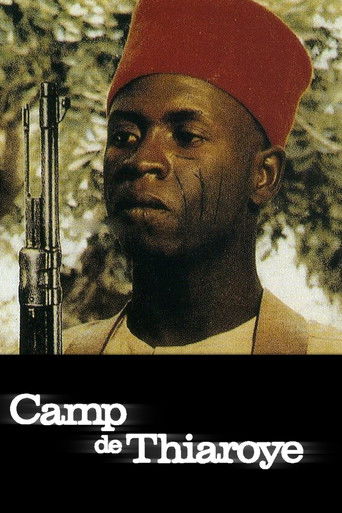
Camp de Thiaroye (1988)
A Senegalese platoon of soldiers from the French Free Army return from combat and are temporarily held in a military encampment with barbed wire fences and guard towers in the desert. Among them are charismatic Sergeant Diatta, educated in Paris and has a French wife and child, and Pays, a soldier left in a state of shock who can only communicate in guttural screams and grunts.
- Erscheinungsdatum
- 1988-09-06
- TMDB
- 7.5 / 10 (22)
- Laufzeit
- 2 Std. 34 Min.
- Genres
- Kriegsfilm, Drama
- Regie
- Ousmane Sembène, Thierno Faty Sow
Besetzung
- Sidiki Bakaba
- Hamed Camara
- Philippe Chamelat
- Moussa Cissoko
- Marthe Mercadier
- Ismaila Cissé
- Ababacar Sy Cissé
- Eloi Coly
- Ismaël Lô
- Pierre Londiche
- Camara Med Dansogho
- El Hadg Ndiaye
Wissenswertes
Camp de Thiaroye is a 1988 Senegalese war-drama film written and directed by Ousmane Sembène and Thierno Faty Sow. It depicts the Thiaroye massacre, which occurred on the morning of December 1, 1944 in Thiaroye, Dakar. In the weeks leading up to the massacre, members of the Senegalese Tirailleurs at the Thiaroye military camp had been protesting poor camp conditions and revocation of promised demobilization benefits. With the camp declared to be in open mutiny, French forces opened fire on the mutineers. French authorities reported a death toll of 35, but estimates range up to 300.
Production
The film is similar to an earlier work by Sembène, Emitaï (1971), which references the Effok massacre—an event in which a village was destroyed by colonial forces in 1943. The underlying aim is the same: to create a historical film that denounces colonialism.
Thierno Faty Sow decided to write the film after his father recounted his own experiences from 1944, when he was working as a postal inspector: he had written a piece for a newspaper and was asked to retract an article in which he criticized the colonists; subsequently transferred to a remote part of Senegal, he resigned and was not reinstated until 1951.
According to Cécile Van den Avenne, the screenplay uses its characters as archetypes, a choice that serves its political message; she cites the example of Staff Sergeant Diatta—a man who is highly acculturated yet out of place in both French and African societies, and consequently vulnerable.
Ousmane Sembène trained at film schools in the USSR during the 1960s. In Camp de Thiaroye, two scenes reference the Soviet cinema classic Battleship Potemkin: the scene where the tirailleurs protest the very poor quality of the food evokes a similar scene that sparks the mutiny on the Russian battleship, while the final massacre scene recalls the moment the Potemkin mutineers fire their cannons.
Auf Wikipedia weiterlesen · Text aus Wikipedia, CC BY-SA 4.0. Daten aus Wikidata.
Empfohlen
- Tobruk 1967 · ★ 6.4
- Hölzerne Kreuze 1932 · ★ 7.1
- The Last Rifleman 2023 · ★ 6.6
- Unbeugsam - Defiance 2008 · ★ 6.8
- De Gaulle: Liberté 2026 · ★ 7.8
- Jacknife - Vom Leben betrogen 1989 · ★ 6.4
- Beasts of No Nation 2015 · ★ 7.6
- Thank You for Your Service 2017 · ★ 6.6
- Zulu 1964 · ★ 7.4
- Flyboys - Helden der Lüfte 2006 · ★ 6.5
- Austerlitz - Glanz einer Kaiserkrone 1960 · ★ 6.7
- Sie nannten ihn King 1965 · ★ 7.1