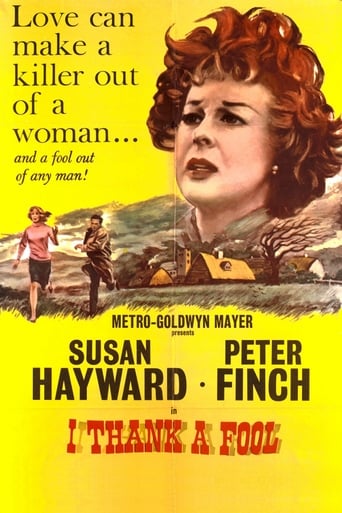
I Thank a Fool (1962)
After mercifully killing her terminally ill lover, Dr. Christine Allison loses her medical license and spends two years in prison. Once she has completed her sentence, the lawyer who prosecuted Christine, Stephen Dane, hires her to care for his emotionally unstable wife, Liane. Christine takes the job, but when Liane's allegedly dead father reappears, Christine sets out to reveal the family's dark secrets.
- Erscheinungsdatum
- 1962-09-14
- TMDB
- 6.1 / 10 (7)
- Laufzeit
- 1 Std. 40 Min.
- Genres
- Drama
- Regie
- Robert Stevens
Besetzung
- Susan Hayward — Christine Allison
- Peter Finch — Stephen Dane
- Diane Cilento — Liane Dane
- Cyril Cusack — Captain Ferris
- Kieron Moore — Roscoe
- Richard Wattis — Ebblington
- Athene Seyler — Aunt Heather Chandler
- Miriam Karlin — Woman in the Black Maria
- Laurence Naismith — O'Grady
- J.G. Devlin — Coroner
- Clive Morton — Judge
- Richard Leech — Irish Doctor
Wissenswertes
I Thank a Fool is a 1962 British Metrocolor crime film directed by Robert Stevens and starring Susan Hayward and Peter Finch. It was made by Eaton and Metro-Goldwyn-Mayer in CinemaScope and produced by Anatole de Grunwald from a screenplay by Karl Tunberg based on the 1958 novel of the same title by Audrey Erskine Lindop. The music score was by Ron Goodwin and the cinematography by Harry Waxman.
Production
The film was based on a novel. Sol C. Siegel bought the film rights in March 1957, prior to publication, as a vehicle for Inger Stevens who the producer had under personal contract. The author was going to write the script. In June 1957 Peter Glenville signed to direct. By August the lead role was given to Ingrid Bergman with filming to take place in England and Ireland.
In January 1958 MGM announced the movie would be made in England that year. The same month John Patrick was reported as working on the script. However in March Grenville dropped out due to competing commitments. Filming kept being delayed. In July 1960 MGM announced the film's stars would be Susan Hayward and Stewart Granger. Eventually Granger dropped out and was replaced by Peter Finch.
De Grunwald had originally hired Gail Kubik to compose the score. Kubik had composed and recorded the score with the London Symphony Orchestra. But when MGM refused to relinquish the music rights, Kubik pulled his score from the production, and Ron Goodwin was hired to re-compose the score. Kubik later reworked his music into his composition Scenes for Orchestra.
Auf Wikipedia weiterlesen · Text aus Wikipedia, CC BY-SA 4.0. Daten aus Wikidata.
Empfohlen
- Halt auf freier Strecke 2011 · ★ 6.8
- Linda's Child 2013 · ★ 6.0
- Schweigegeld für Liebesbriefe 1949 · ★ 6.8
- Eleanor the Great 2025 · ★ 6.8
- Das Quiller Memorandum - Gefahr aus dem Dunkel 1966 · ★ 5.9
- Outrage 1950 · ★ 6.5
- Return 2011 · ★ 6.4
- Zeugin des Mordes 1954 · ★ 6.3
- Abgekartetes Spiel 1947 · ★ 6.5
- Seeds of Yesterday 2015 · ★ 6.4
- Feind im Dunkel 1946 · ★ 6.6
- Islands 2025 · ★ 6.1