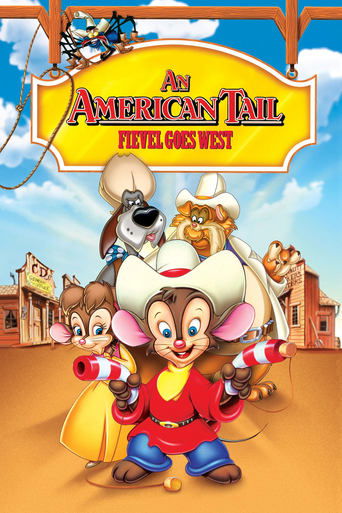
An American Tail: Fievel Goes West (1991)
Look out pardners, there's a new mouse in town!
Some time after the Mousekewitz's have settled in America, they find that they are still having problems with the threat of cats. That makes them eager to try another home out in the west, where they are promised that mice and cats live in peace. Unfortunately, the one making this claim is an oily con artist named Cat R. Waul who is intent on his own sinister plan.
- Date of release
- 1991-11-21
- TMDB
- 6.3 / 10 (831)
- Runtime
- 1h 15m
- Genres
- Animation, Family, Western, Adventure, Comedy
- Director
- Simon Wells, Phil Nibbelink
- Collection
- An American Tail Collection
Casting
- Phillip Glasser — Fievel Mousekewitz (voice)
- James Stewart — Wylie Burp (voice)
- Erica Yohn — Mama Mousekewitz (voice)
- Cathy Cavadini — Tanya Mousekewitz (voice)
- Nehemiah Persoff — Papa Mousekewitz (voice)
- Dom DeLuise — Tiger (voice)
- Amy Irving — Miss Kitty (voice)
- John Cleese — Cat R. Waul (voice)
- Jon Lovitz — Chula (voice)
- Jack Angel — Frenchy (voice)
- Fausto Bara — Additional Voices (voice)
- Vanna Bonta — Additional Voices (voice)
Interesting facts
- Budget: $16.5M
An American Tail: Fievel Goes West is a 1991 American animated Western musical comedy film directed by Phil Nibbelink and Simon Wells, with producer Steven Spielberg for Amblin Entertainment and animated by his Amblimation animation studio and released by Universal Pictures. A sequel to 1986's An American Tail, the film follows the story of the Mousekewitzes, a family of Russian-Jewish mice who emigrate to the Wild West. In it, Fievel is separated from his family as the train approaches the American Old West; the film chronicles him and Sheriff Wylie Burp teaching Tiger how to act like a dog.
Production
A sequel to Steven Spielberg's An American Tail (1986) under the working title An American Tail II was put into pre-production by David Kirschner in April 1988 after he finished producing Child's Play (1988); when announcing the project that same month, he summarized that Fievel will "fight the cat-tle barons. It's like a John Ford western with Jewish mice".
Spielberg produced the live-action animated film Who Framed Roger Rabbit (1988), which was the top grossing motion picture of 1988. As a way to keep the movie's animators working, due to the closure of Richard Williams Animation, Spielberg formed Amblimation, a collaboration of Universal City Studios and Amblin Entertainment, whose offices were located in London.
Don Bluth, who had partnered with Spielberg on both the original film and The Land Before Time (1988), was set to direct and have Sullivan Bluth Studios provide the animation; owing to creative differences, however, they parted ways. As Bluth explained, "the business deal wasn't such that it helped our company".
With John Cleese as the first choice for Cat R. Waul, he was approached in 1989 by one of the film's producers at what Cleese vaguely called "the Italian Oscars". He accepted the offer based on his enjoyment of the first American Tail and "I love sound studios anyway – there's none of the hassle and boredom and time wasting you get in television".
Don Bluth's departure from the project resulted in the animation of Fievel Goes West lacking the Disney-isms of the first film's animation. Instead, its animation is faster-paced and contains more elements of Warner Bros. cartoons. Spielberg instructed his animators to take on a "live-action" method to animating the film, where the characters are affected by parts of the environment such as lighting.
Read on Wikipedia · Text from Wikipedia, CC BY-SA 4.0. Data from Wikidata.
Recommended
- Rango 2011 · ★ 6.9
- Tom and Jerry Cowboy Up! 2022 · ★ 6.9
- An American Tail: The Mystery of the Night Monster 1999 · ★ 6.3
- The Wild Thornberrys Movie 2002 · ★ 6.5
- Puss in Boots 2011 · ★ 6.6
- Hey Arnold! The Jungle Movie 2018 · ★ 7.6
- The Fox and the Hound 2 2006 · ★ 6.0
- Scooby-Doo! Shaggy's Showdown 2017 · ★ 7.7
- Clifford's Really Big Movie 2004 · ★ 6.2
- PAW Patrol: The Dino Movie 2026 · ★ 8.2
- The Secret Life of Pets 2 2019 · ★ 6.9
- Open Season 2 2008 · ★ 5.9