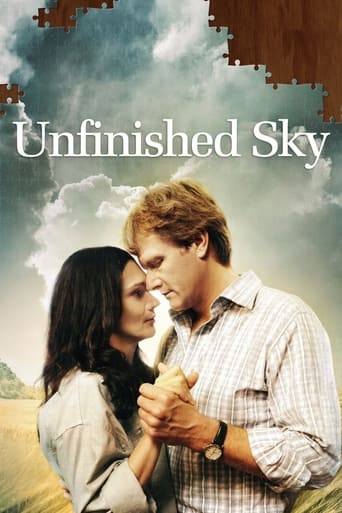
Unfinished Sky (2007)
An Outback farmer takes in an Afghani woman who has fled from a brothel.
- Date de sortie
- 2007-08-04
- TMDB
- 6.2 / 10 (23)
- Durée
- 1 h 34 min
- Genres
- Romance, Drame
- Réalisateur
- Peter Duncan
Distribution
- William McInnes — John Woldring
- Monic Hendrickx — Tahmeena
- Bille Brown — Bob Potter
- Christopher Sommers — Mike Potter
- David Field — Sgt. Carl Allen
- Milo — Elvis
- Sam Cotton — Angus
- Kristina Andersen — Supermarket Shopper
- Renai Caruso — Kate
- Zulaikha Deen — Shahla (6yo)
- Roy Billing — Royce
- Mercia Deane-Johns — Barbara
Anecdotes
- Box-office : 966,2 k $AU
- Récompenses : 6 · Nominations : 10. Dont : AACTA Award du meilleur scénario adapté; AACTA Award du meilleur acteur; AACTA Award de la meilleure photographie; AACTA Award de la meilleure actrice
Unfinished Sky is a 2007 drama film written and directed by Peter Duncan. William McInnes stars as John Woldring, an Australian farmer living in self-imposed exile after his wife's death, who rescues and protects Tahmeena, played by Monic Hendrickx, an Afghan refugee who has escaped abusive local townsfolk. Deliberated by scholars and Peter Duncan as a film focused on the response to 9/11, Unfinished Sky has also been described as post-national cinema, with themes of isolation, the fear of others, and the overcoming of obstacles, all relating to Australian identity.
Production
The involvement and investment of New Holland Pictures, a combination of the Dutch company responsible for the production The Polish Bride and an Australian pair, Cathy and Mark Overett, was vital in the creation of Unfinished Sky.
Peter Duncan adapted the Dutch film in an Australian setting in response to the impact of 9/11; it was shot mainly in Beaudesert, Queensland, south of Brisbane. In an interview with Matthew Pejkovic, Duncan describes the film as being ‘about overcoming those fears,’ in relation to his earlier comment on ‘how people have become more fearful of each other’; he thus highlights the central message of overcoming distrust of difference.
The cinematography of the film, headed by Robert Humphries, attempts to mimic the characterisation and interaction of the two protagonists. The film is split into two parts; the opening half is distinguished by a more tonally grey image, a result of a slight crushing of colour, reflecting the coarseness of interaction between the protagonists.
Camera work is also used to metaphorically represent the characters' internal perceptions of the landscape. Duncan in an interview with Brian McFarlane says that the setting is related to John's perspective: "He’s so lost his sense of place that he doesn’t notice the beauty around him." Later sections of the film present the countryside in more vivid tones.
Lire sur Wikipédia · Texte de Wikipédia, CC BY-SA 4.0. Données de Wikidata.
Recommandés
- Une liaison pornographique 1999 · ★ 6.3
- Newness 2017 · ★ 6.1
- Pour l'amour de Sylvie 2020 · ★ 6.2
- See You Soon 2019 · ★ 5.9
- Wander Darkly 2020 · ★ 6.0
- L'Homme à la peau de serpent 1960 · ★ 6.9
- Hiver, Printemps, Été ou Automne 2024 · ★ 7.3
- Deux sur la balançoire 1962 · ★ 6.5
- Time Is Up 2021 · ★ 6.5
- César et Rosalie 1972 · ★ 7.2
- L'Homme d'Elysian Fields 2001 · ★ 5.9
- Mon roi 2015 · ★ 7.1