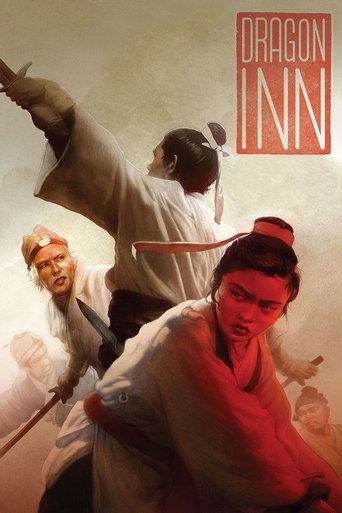
Dragon Inn (1967)
龍門客棧
China, year 1457. The Minister of Defense is executed, and his children are sentenced to exile by order of the tyrannical Tsao. Fearful of future revenge from the young people, Tsao sends cruel soldiers to murder them, but a brave group of swordsmen can change the course of the battle at the Dragon Inn.
- Date of release
- 1967-11-23
- TMDB
- 7.4 / 10 (152)
- Runtime
- 1h 51m
- Genres
- Action, Adventure
- Director
- King Hu
- Collection
- Dragon Inn Collection
Casting
- Shih Chun — Hsiao Shao-Tzu
- Pai Ying — Tsao Shao Chin
- Polly Shang-Kuan Ling-Feng — Miss Chu Huei
- Miao Tian — Pi Shao-Tung
- Han Ying-chieh — Mao Zong-Xian
- Tsao Chien — General Wu Ning
- Hsueh Han — Chu Chi
- Go Ming — Bookkeeper at Inn
- Ko Hsiao-Pao — Waiter at Inn
- Ko Fei — Kuei Yu Chang
- Hsu Feng — Yu Chien's Daughter
- Wan Chung-Shan — Tou La
Interesting facts
Dragon Inn (龍門客棧), also known as Dragon Gate Inn, is a 1967 Taiwanese wuxia film written and directed by King Hu. Set in 15th-century China during the Ming dynasty, the film follows a small, disparate band of martial artists who protect the exiled family members of a respected official from persecution by a treacherous eunuch and the secret police.
Production
Prior to the financial success of director King Hu's Come Drink with Me (1966) he had left the Shaw Brothers Studio. Cinematographer Nishimoto Tadashi said that money was also a factor for Hu's departure as while Come Drink With Me was performing well in the box office, he was only being paid HKD 2,500 for his film. In 1965, director King Hu left the Hong Kong-based Shaw Brothers Studio just after completing Come Drink with Me.
According to mainland China critic Song Ziwen, Hu had wanted to make another wuxia film for the company based on the short story "The Painted Skin" Hu dropped this idea and would only return to that subject for his last film, Painted Skin (1992).
After failing to maintain Hu as a director, Shaw Brothers sent Raymond Chow to Taiwan to negotiate with Union's Sha Youngfung as Shaw Brothers insisted that Hu still contractually owed them six more films. Shaw Brothers wanted Union to give them the distribution rights to the next four King Hu films in Singapore, Malaysia and Burma.
Hu himself credited the combat techniques to the choreography of Han Ying-chieh, better known as the titular villain in the film The Big Boss (1971). Han Ying-chieh had trained in the Peking Opera with Hu stating they had designed their combat scenes as being more like ballets instead of plausible fights.
Read on Wikipedia · Text from Wikipedia, CC BY-SA 4.0. Data from Wikidata.
Recommended
- Crouching Tiger, Hidden Dragon: Sword of Destiny 2016 · ★ 6.2
- The Forbidden Kingdom 2008 · ★ 6.7
- Hero 2002 · ★ 7.5
- House of Flying Daggers 2004 · ★ 7.3
- Street Fighter: Assassin's Fist The Movie 2014 · ★ 7.3
- Detective Dee: The Four Heavenly Kings 2018 · ★ 6.3
- Detective Dee and the Mystery of the Phantom Flame 2010 · ★ 6.6
- Dragonheart: Vengeance 2021 · ★ 6.9
- The Storm Riders 1998 · ★ 6.5
- Eye for an Eye 2022 · ★ 7.1
- The Banquet 2006 · ★ 6.1
- The Lost Bladesman 2011 · ★ 6.2