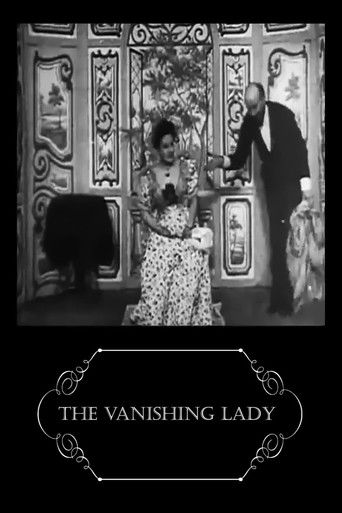
The Vanishing Lady (1896)
Escamotage d'une dame chez Robert-Houdin
Georges Méliès makes a woman disappear, then reappear.
- Date of release
- 1896-01-01
- TMDB
- 6.2 / 10 (135)
- Runtime
- 1m
- Genres
- Mystery
- Director
- Georges Méliès
Casting
- Georges Méliès — Фокусник
- Jehanne d'Alcy — Дама
Interesting facts
The Vanishing Lady is an 1896 French silent trick film directed by Georges Méliès. It features Méliès and Jehanne d'Alcy performing a trick in the manner of a stage illusion, in which D'Alcy disappears into thin air. A skeleton appears in her place before she finally returns for a curtain call.
Production
The Vanishing Lady is based on a magic act by the French magician Buatier de Kolta. Méliès had already imitated the act onstage in his own venue, the Théâtre Robert-Houdin in Paris. When the illusion was produced onstage, stage machinery was used to make the magician's assistant disappear.
In the filmed version, Méliès appears as the magician, and his assistant is Jehanne d'Alcy. D'Alcy, a performer at the Théâtre Robert-Houdin, had had much experience with the stage version of the illusion, in which her small stature was ideal for the escape down the trapdoor. The setting, seemingly an interior in Rococo style, was built of theatrical flats on a small outdoor platform Méliès had set up in his garden at Montreuil-sous-Bois.
The beginning of the film closely follows the Buatier de Kolta stage illusion, complete with the newspaper and shawl props. On film, however, Méliès needed no trapdoor, using instead an editing technique called the substitution splice—the first known instance of his using this effect.
Although he later claimed to have invented the technique independently, after his camera accidentally became jammed, Méliès probably developed the splice after seeing a rudimentary version in an 1895 Edison Manufacturing Company film The Execution of Mary Stuart.
Read on Wikipedia · Text from Wikipedia, CC BY-SA 4.0. Data from Wikidata.
Recommended
- Brand Upon the Brain! 2007 · ★ 6.6
- Nancy Drew and the Hidden Staircase 2019 · ★ 6.3
- The Paradine Case 1947 · ★ 6.3
- Maigret Sets a Trap 1958 · ★ 7.1
- Framed for Murder: A Fixer Upper Mystery 2017 · ★ 6.6
- The Dollmaker 2017 · ★ 7.0
- Under the Silver Lake 2018 · ★ 6.3
- Rabbits 2002 · ★ 6.7
- The Crime is Mine 2023 · ★ 6.5
- Original Sin 2001 · ★ 6.2
- The Stone Tape 1972 · ★ 6.0
- Scooby-Doo! Abracadabra-Doo 2010 · ★ 7.7