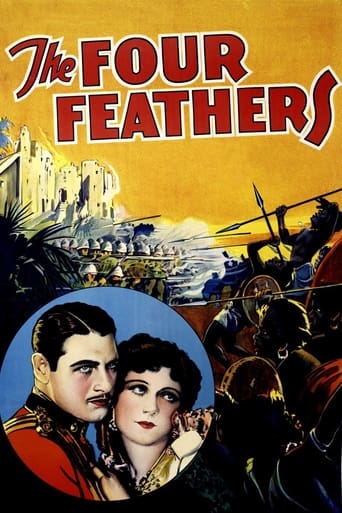
The Four Feathers (1929)
Paramount's new sensation!
An Englishman (Richard Arlen) fights in the Sudan after receiving white feathers of cowardice from his fiancee (Fay Wray) and friends.
- Date of release
- 1929-06-01
- TMDB
- 5.0 / 10 (8)
- Runtime
- 1h 21m
- Genres
- Drama, Adventure
- Director
- Merian C. Cooper, Ernest B. Schoedsack, Lothar Mendes
Casting
- Richard Arlen — Lt. Harry Faversham
- Fay Wray — Ethne Eustace
- Clive Brook — Lt. Jack Durrance
- William Powell — Capt. William Trench
- Theodore von Eltz — Lt. Castleton
- Noah Beery — Slave Trader
- Zack Williams — Idris
- Noble Johnson — Ahmed
- Harold Hightower — Ali
- Philippe De Lacy — Harry Faversham - age 10
- E.J. Ratcliffe — Col. Eustace
- George Fawcett — Col. Faversham
Interesting facts
- Based on: The Four Feathers
The Four Feathers is a 1929 American synchronized sound war film directed by Merian C. Cooper and starring William Powell, Richard Arlen, Clive Brook and Fay Wray. This was the third of numerous film versions of the 1902 novel The Four Feathers written by A. E. W. Mason. While the film has no audible dialog, it was released with a synchronized musical score with sound effects using both the sound-on-disc and sound-on-film process. The 1929 version of The Four Feathers premiered at the Criterion Theatre in New York City in June 1929.
Production
The picture has the distinction of being one of the last major Hollywood pictures to be released without audible dialogue. The soundtrack was recorded by Paramount Pictures using the Western Electric Sound System recording process. The synchronized film featured a musical score with sound effects.
The book the film was based on, The Four Feathers (1902), was one of the only books in Cooper's possession while he served as a volunteer for the Polish resistance in Kościuszko's Squadron. Cooper found the book inspirational. Kamran Rastegar, associate professor of Arabic and comparative literature at Tufts University, noted several parallels between Cooper's life and that of the protagonist of Four Feathers: both were born into military familie…
Cooper, Shoedsack, and Shoedsack's wife, Ruth Rose, traveled to Tanzania and Sudan to shoot parts of the film in 1927. Cooper wrote "Two Fighting Tribes of Sudan" for a 1929 National Geographic article using material from the expedition. Film from the expedition was interweaved with parts shot on sets in Hollywood. Actors were not transported to Sudan, which helped reduce filming costs.
Adolph Zukor, Paramount studio head, insisted on the film having no talking sequences, even though the directors wanted it to be a talkie. The film has been billed as the "last of the big silent films" even though it had a soundtrack and sound effects. According to Thomas Schatz, producer Selznick saved the film from disaster by conducting retakes and reediting the film after its initial preview.
Read on Wikipedia · Text from Wikipedia, CC BY-SA 4.0. Data from Wikidata.
Recommended
- The Four Feathers 1939 · ★ 7.1
- Play Dirty 1969 · ★ 6.3
- End of Sentence 2019 · ★ 6.2
- Black Gold 2011 · ★ 6.5
- The Charge of the Light Brigade 1968 · ★ 6.2
- Prizefighter: The Life of Jem Belcher 2022 · ★ 6.2
- Man with No Past 2025 · ★ 6.5
- Embattled 2020 · ★ 6.7
- Hurricane 2018 · ★ 5.9
- Jawbone 2017 · ★ 6.1
- Danny Boy 2021 · ★ 6.8
- Interceptor 2022 · ★ 6.0