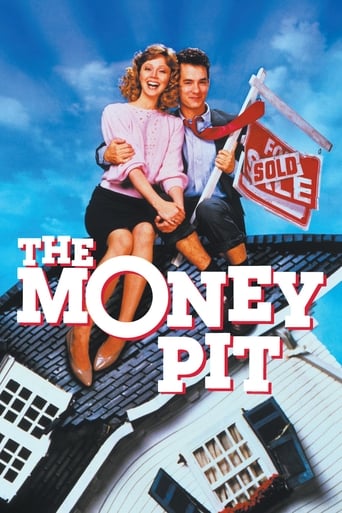
The Money Pit (1986)
For everyone who's ever been deeply in love or deeply in debt.
After being evicted from their Manhattan apartment, a couple buy what looks like the home of their dreams—only to find themselves saddled with a bank-account-draining nightmare. Struggling to keep their relationship together as their rambling mansion falls to pieces around them, the two watch in hilarious horror as everything—including the kitchen sink—disappears into the Money Pit.
- Date of release
- 1986-03-26
- TMDB
- 6.5 / 10 (1311)
- Runtime
- 1h 31m
- Genres
- Comedy, Romance
- Director
- Richard Benjamin
Casting
- Tom Hanks — Walter Fielding, Jr.
- Shelley Long — Anna Crowley
- Alexander Godunov — Max Beissart
- Maureen Stapleton — Estelle
- Joe Mantegna — Art Shirk
- Philip Bosco — Curly
- Josh Mostel — Jack Schnittman
- Yakov Smirnoff — Shatov
- Carmine Caridi — Brad Shirk
- Brian Backer — Ethan
- Billy Lombardo — Benny
- Mia Dillon — Marika
Interesting facts
- Box office: $55M
- Budget: $18.4M
- Earned 3× its budget
- Filmed in: New York City
The Money Pit is a 1986 American comedy film directed by Richard Benjamin and starring Tom Hanks and Shelley Long as Walter Fielding and Anna Crowley, a couple who attempt to renovate a recently purchased house. The film is a loose remake of the 1948 Cary Grant comedy film Mr. Blandings Builds His Dream House, and was filmed in New York City and Lattingtown, New York. It was co-executive produced by Steven Spielberg.
Production
Kathleen Turner was originally offered the role of Anna Crowley, but she declined in favor of The Jewel of the Nile.
Principal photography began on April 29, 1985, and initially ended on August 5, 1985.
Exterior shots used a relatively rundown house in Lattingtown, Long Island that had been built in 1898 in the Colonial style. After the film, it was purchased for $2.1 million in 2002. In November 2019, the Seattle PI reported that the Long Island house had "finally" sold for around $3.5 million, at a significant loss in relation to renovation costs.
Over Thanksgiving 1985, a new opening was shot on the Universal Studios lot.
The production designer, Patrizia Von Brandenstein, won the Academy Award for Art Direction for her work on Amadeus (1984) shortly before production began on The Money Pit. The nature of the action in dictated that the scenes be shot in order. The house sets were also built as modules that could easily be disassembled. Although Roger Ebert's review of the film was generally negative, he noted it was "a triumph of art direction.
Read on Wikipedia · Text from Wikipedia, CC BY-SA 4.0. Data from Wikidata.
Recommended
- American Dreamer 2022 · ★ 6.0
- Duplex 2003 · ★ 6.1
- Find Me Falling 2024 · ★ 6.6
- Who's Minding the Store? 1963 · ★ 6.8
- One Crazy Summer 1986 · ★ 6.0
- Isn't It Romantic 2019 · ★ 6.2
- Overboard 1987 · ★ 6.9
- Seems Like Old Times 1980 · ★ 6.3
- Watching the Detectives 2007 · ★ 6.3
- Housesitter 1992 · ★ 6.2
- All of My Heart 2015 · ★ 6.9
- Joe's Apartment 1996 · ★ 5.8