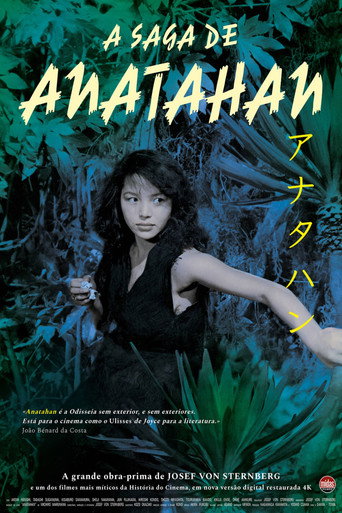
A Saga de Anatahan (1953)
アナタハン
Inspirado por uma história real. Durante a Segunda Guerra Mundial, quinze marinheiros sobrevivem ao bombardeamento do seu navio e ficam isolados na ilha remota de Anatahan. A guerra chega ao fim – facto que desconhecem – e continuam a sua própria guerra, pelo domínio da ilha e pela posse da única mulher entre eles, Keiko, a Abelha-Mestra de Anatahan.
- Data de estreia
- 1953-06-28
- TMDB
- 6.8 / 10 (50)
- Duração
- 1 h 31 min
- Géneros
- Drama, Guerra
- Realizador
- Josef von Sternberg
Elenco
- 根岸明美 — Keiko Kusakabe
- 菅沼正 — Kusakabe, Husband of Keiko
- Kisaburo Sawamura — Kuroda
- 中山昭二 — Nishio
- 藤川準 — Yoshisato
- 近藤宏 — Yanaginuma
- Shozo Miyashita — Sennami
- Kikuji Onoe — Kaneda
- Rokuriro Kineya — Marui
- Tsuruemon Bando — Doi
- Daijiro Tamur — Kanzaki
- 喜多川千鶴 — A Homesick One
Curiosidades
Anatahan (アナタハン), also known by its on-screen title of The Saga of Anatahan, is a 1953 black-and-white Japanese war drama film directed by Josef von Sternberg, with special effects by Eiji Tsuburaya. It was adapted by Sternberg from Michiro Maruyama's nonfiction account of the seven years he and a group of World War II Japanese holdouts spent on Anatahan island, which was then part of the South Seas Mandate of Imperial Japan and is now one of the Northern Mariana Islands of the United States.
Production
Daiwa Productions, Inc., an independent Japanese film production company, was founded in 1952 solely for the purpose of making Anatahan. The co-executives included Sternberg, Nagamasa Kawakita, and Yoshio Osawa, the latter two of whom were entrepreneurial international film distributors.
Kawakita established the Towa Trading Company in 1928 to promote an exchange of Japanese and European films in “the urban art cinema market.” He also acted as a representative for German film corporation UFA GmbH in Japan.
German director-producer Arnold Fanck joined with Kawakita in 1936 to produce the German-Japanese propaganda film The Daughter of the Samurai (entitled The New Earth in English language releases and Die Tocher der Samurai in Germany) to foster mutual cultural bonds between the countries.
Sternberg travelled to Japan in 1937, shortly after ending his professional ties with Paramount Pictures and Columbia Pictures. He met with Japanese critics and film enthusiasts who had studied and admired his silent and sound films. Kawakita and Fanck were filming The New Earth at the time, and Sternberg visited them on location to discuss a possible collaboration, but the talks were suspended when war broke out in 1939.
Both Kawakita and Osawa served Imperial Japan throughout the war, producing propaganda films in China and Japan, respectively. When Japan was defeated in 1945, the Supreme Commander for the Allied Powers (SCPA) designated both producers as Class B war criminals, barring them from the Japanese film industry until 1950.
Ler na Wikipédia · Texto da Wikipédia, CC BY-SA 4.0. Dados do Wikidata.
Recomendados
- Waiting for Anya 2020 · ★ 6.3
- Jacknife 1989 · ★ 6.4
- A Grande Batalha 1949 · ★ 6.7
- Feliz Natal, Mr. Lawrence 1983 · ★ 7.3
- Patrulha Sem Nome 1992 · ★ 6.5
- Birdy - Asas da Liberdade 1984 · ★ 7.1
- Ararat 2002 · ★ 6.1
- Flags of our Fathers - As Bandeiras dos Nossos Pais 2006 · ★ 6.9
- The Last Rifleman 2023 · ★ 6.6
- Walking with the Enemy 2014 · ★ 6.3
- Os Que Sabem Morrer 1957 · ★ 6.6
- A Besta da Guerra 1988 · ★ 7.1