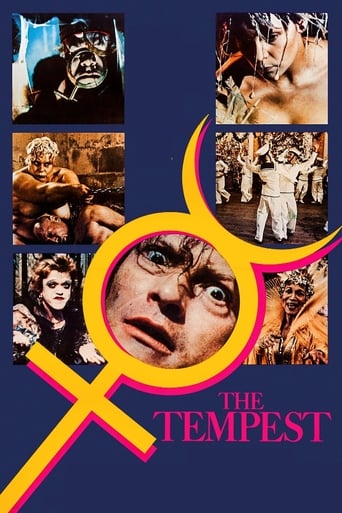
The Tempest (1979)
“We are such stuff as dreams are made on and our little life is rounded with a sleep.”
Prospero, a potent magician, lives on a desolate isle with his virginal daughter, Miranda. He's in exile, banished from his duchy by his usurping brother and the King of Naples. Providence brings these enemies near; aided by his vassal the spirit Ariel, Prospero conjures a tempest to wreck the Italian ship. The king's son, thinking all others lost, becomes Prospero's prisoner, falling in love with Miranda and she with him. Prospero's brother and the king wander the island, as do a drunken cook and sailor, who conspire with Caliban, Prospero's beastly slave, to murder Prospero. Prospero wants reason to triumph, Ariel wants his freedom, Miranda a husband; the sailors want to dance.
- Date of release
- 1979-09-13
- TMDB
- 5.8 / 10 (27)
- Runtime
- 1h 35m
- Genres
- Drama, Fantasy
- Director
- Derek Jarman
Casting
- Heathcote Williams — Prospero, the Right Duke of Milan
- Toyah Willcox — Miranda, his daughter
- Karl Johnson — Ariel, an airy spirit
- Jack Birkett — Caliban, a savage and deformed slave
- Peter Bull — Alonso, the King of Naples
- David Meyer — Ferdinand, his son
- Neil Cunningham — Sebastian, his brother
- Richard Warwick — Antonio, his brother
- Christopher Biggins — Stephano, a drunken mariner
- Peter Turner — Trinculo, his friend
- Ken Campbell — Gonzalo, an honest councillor
- Elisabeth Welch — A Goddess
Interesting facts
The Tempest is a 1979 film adaptation of William Shakespeare's play of the same name. Directed by Derek Jarman, produced by Don Boyd, with Heathcote Williams as Prospero, it also stars Toyah Willcox, Jack Birkett, Karl Johnson and Helen Wellington-Lloyd from Jarman's previous feature, Jubilee (1977).
Production
Jarman had been working on adapting The Tempest for several years before filming began, working on an adaptation for the stage before settling on a film adaptation. He was attracted to Shakespeare's original play due to the themes of forgiveness he saw throughout the text.
The movie was part of a slate of films worth £3 million in all produced by Don Boyd.
The film was shot inside Stoneleigh Abbey, Warwickshire. Jarman chose the location due to budget constraints, as the abbey created the atmosphere he wanted without needing access to an expansive or exotic set.
The costuming draws on the styles of multiple eras, meant to serve as "a chronology of 350 years of the play's existence, like the patina on old bronze." The combination of styles is made to reference the production history of the play as well as draw on modern aesthetics familiar to 20th century audiences.
In his production notes, Jarman states that he took stylistic inspiration from films such as Rosemary's Baby (1968) and films produced by Hammer Film Productions.
Read on Wikipedia · Text from Wikipedia, CC BY-SA 4.0. Data from Wikidata.
Recommended
- The Shepherd 2023 · ★ 7.0
- Nine Days 2021 · ★ 6.8
- Northfork 2003 · ★ 6.0
- Game of Thrones The IMAX Experience 2015 · ★ 8.6
- Prospero's Books 1991 · ★ 6.8
- The Good Witch's Gift 2010 · ★ 7.6
- Skater Girl 2021 · ★ 7.2
- Walkaway Joe 2020 · ★ 6.0
- All That Money Can Buy 1941 · ★ 7.0
- Mythica: A Quest for Heroes 2014 · ★ 5.8
- The Good Witch's Family 2011 · ★ 7.3
- End of Sentence 2019 · ★ 6.2