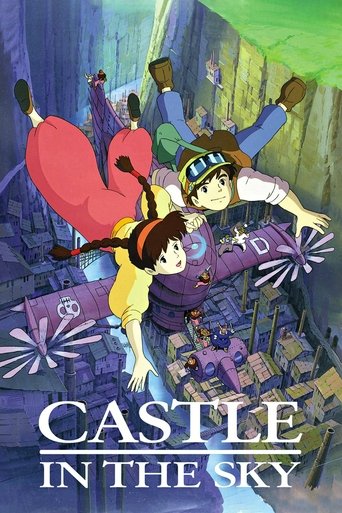
Castle in the Sky (1986)
天空の城ラピュタ
One day, a girl came down from the sky…
A young boy and a girl with a magic crystal must race against pirates and foreign agents in a search for a legendary floating castle.
- Date of release
- 1986-08-02
- TMDB
- 8.0 / 10 (4875)
- Runtime
- 2h 5m
- Genres
- Adventure, Fantasy, Animation, Action, Family
- Director
- Hayao Miyazaki
Casting
- Keiko Yokozawa — Sheeta (voice)
- Mayumi Tanaka — Pazu (voice)
- Minori Terada — Muska (voice)
- Kotoe Hatsui — Dola (voice)
- Fujio Tokita — Uncle Pomme (voice)
- Ichiro Nagai — Shogun Mouro (voice)
- Hiroshi Ito — Oyakata (voice)
- Machiko Washio — Okami (voice)
- Takuzō Kamiyama — Charles / Shalulu (voice)
- Yoshito Yasuhara — Louis (voice)
- Sukekiyo Kameyama — Henri (voice)
- Eken Mine — Underling (voice)
Interesting facts
- Box office: $16.1M
- Budget: $3M
- Earned 5.4× its budget
Castle in the Sky, also known as Laputa: Castle in the Sky, is a 1986 Japanese animated fantasy adventure film written and directed by Hayao Miyazaki. It was produced by Isao Takahata, animated by Studio Ghibli, and distributed by the Toei Company. The film stars the voices of Mayumi Tanaka, Keiko Yokozawa, Kotoe Hatsui, and Minori Terada. In the film, orphans Sheeta and Pazu are pursued by government agent Muska, the army, and a group of pirates. They seek Sheeta's crystal necklace, the key to accessing Laputa, a legendary flying castle hosting advanced technology.
Development
Following the success of his previous film, Nausicaä of the Valley of the Wind (1984), Hayao Miyazaki began looking for different projects to direct. Tokuma Shoten, the company backing Miyazaki financially, proposed producing a follow-up to Nausicaä, which he refused. He envisioned creating an old-fashioned adventure film that would be a "pleasure" to watch, for which he took a research trip to the city of Yanagawa.
The film was never produced, but the city's canals inspired Miyazaki's longtime collaborator, Isao Takahata, to propose they create a documentary about them rather than an animation. This eventually became The Story of Yanagawa's Canals (1987), which focused on the environmental effects of industry on the local waterways. A documentary, however, was unlikely to be commercially viable and had no prospect of support from Tokuma Shoten.
Takahata rapidly spent the funds on research; to recover the expense and help complete the filming, Toshio Suzuki, an editor of Animage at the time, recommended that Miyazaki direct another film. According to Suzuki, Miyazaki immediately agreed, and quickly developed a concept for the film based on an idea he had in elementary school.
Miyazaki completed a project proposal in December 1984, tentatively titled Young Boy Pazu. According to the animation scholar Seiji Kanō, its concepts constituted a "direct rebellion" against popular animation trends at the time; instead of a protagonist with superhuman powers and a futuristic setting, the proposal featured an ordinary child within a fantastical nineteenth-century period.
The proposal was also unusual in that it did not adapt an already-successful manga, which weakened its commercial potential. Feeling that it was unlikely to be green-lit, Miyazaki preemptively began work on a back-up proposal. However, Tokuma Shoten was eager to back Young Boy Pazu, and immediately approved it to begin production, with Takahata acting as producer as he had done on Nausicaä.
Read on Wikipedia · Text from Wikipedia, CC BY-SA 4.0. Data from Wikidata.
Recommended
- Peter Pan 2003 · ★ 7.1
- Peter Pan 1953 · ★ 7.2
- Drifting Home 2022 · ★ 7.4
- Pan 2015 · ★ 6.0
- The Wonderland 2019 · ★ 6.4
- The Dark Crystal 1982 · ★ 7.2
- The Sea Beast 2022 · ★ 7.3
- The House of Magic 2013 · ★ 6.3
- Crayon Shinchan the Movie: Dangerous Honeymoon -The Lost Daddy- 2019 · ★ 7.0
- One Piece: Stampede 2019 · ★ 7.8
- The Secret Kingdom 2023 · ★ 6.4
- Dragon Rider 2020 · ★ 6.9