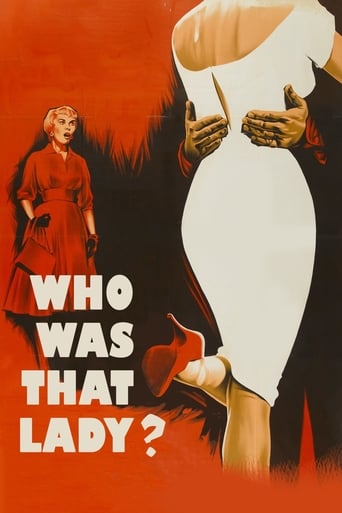
Who Was That Lady? (1960)
A light-hearted leer at love among the adults!
In order to get back into the good graces with his wife with whom he has had a misunderstanding, a young chemistry professor concocts a wild story that he is an undercover FBI agent. To help him with his story he enlists the aid of a friend who is a TV writer. The wife swallows the story and the film's climax takes place in the sub-basements of the Empire State Building. The professor and his friend, believing themselves prisoners on an enemy submarine, patriotically try to scuttle the vessel and succeed only in rocking the building.
- Date of release
- 1960-04-08
- TMDB
- 6.4 / 10 (31)
- Runtime
- 1h 55m
- Genres
- Comedy, Romance
- Director
- George Sidney
Casting
- Tony Curtis — David Wilson
- Dean Martin — Michael Haney
- Janet Leigh — Ann Wilson
- James Whitmore — Harry Powell
- John McIntire — Bob Doyle
- Barbara Nichols — Gloria Coogle
- Larry Keating — Parker
- Larry Storch — Orenov
- Simon Oakland — Belka
- Joi Lansing — Florence Coogle
- Barbara Hines — Foreign Exchange Student
- Marion Javits — Miss Mellish
Interesting facts
Who Was That Lady? is a 1960 black and white American comedy film directed by George Sidney and starring Tony Curtis, Dean Martin, and Janet Leigh.
Production
In July 1958, Columbia bought the film rights to the play and hired Krasna to write the script. Hedda Hopper wrote that she hoped the three leads of the play were used instead of stars as "they took a play that wasn't that good and turned it into a great hit". However the stars Dean Martin and Tony Curtis were clients of Lew Wasserman of MCA, as was Krasna – Wasserman had packaged the project with his clients and sold it to Columbia for $350,000.
In September 1958 George Sidney announced he would make the film as part of a three-picture deal with Columbia, along with Pepe and Here Come the Brides. The production company, Ansark-Sidney, combines the names of producer Krasna (spelled backwards) and director Sidney.
In March 1959, Debbie Reynolds signed to star alongside Dean Martin and Tony Curtis. Martin's fee at this stage was $200,000 per film. By May, Reynolds had dropped out and been replaced by Janet Leigh, then married to Curtis.
Filming started on July 20, 1959. Shortly after filming Leigh called it "the best role I've ever had. The girl is really important in the comedy. Quite a few important changes were made from the stage play because of the expanded movie medium... We had a real ball making the picture; we played practical jokes on each other between scenes that kept everyone in good humor. That George Sidney's a doll too."
Leigh confirmed in her memoirs that making the film "was a romp from start to finish... we really rolled with this one. The personal familiarity of the three of us allowed absolute freedom and the interplay was wild and woolly and inventive."
Read on Wikipedia · Text from Wikipedia, CC BY-SA 4.0. Data from Wikidata.
Recommended
- Sex and the Single Girl 1964 · ★ 6.5
- The Rewrite 2014 · ★ 6.0
- The Prince & Me 2004 · ★ 6.2
- Horse Feathers 1932 · ★ 6.9
- Let's Make Love 1960 · ★ 6.4
- She's the Man 2006 · ★ 6.8
- Vivacious Lady 1938 · ★ 7.0
- Girl on a Bicycle 2013 · ★ 5.9
- Easy Virtue 2008 · ★ 6.5
- What's Love Got to Do with It? 2023 · ★ 6.1
- The Prince & Me 4: The Elephant Adventure 2010 · ★ 6.1
- Housesitter 1992 · ★ 6.2