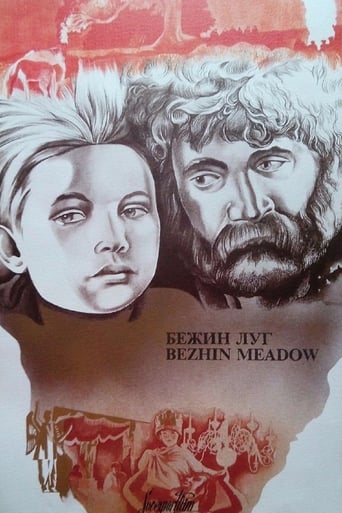
Bezhin Meadow: Sequences from an Unfinished Film (1968)
Бежин луг
Bezhin Lug (Bezhin Meadow) was to be a Soviet film about a young farm boy whose father attempts to betray the government for political reasons by sabotaging the year's harvest, and the son's efforts to stop his own father to protect the Soviet state, culminating in the boy's murder and a social uprising. Assigned to Soviet film-maker Sergei Eisenstein, the filming followed the same path as with his previous effort, "Que Viva Mexico", into cost overrun and over-shooting of footage. Furthermore, Eisenstein's usage of forbidden experimental film techniques outraged his government superiors, who ordered the film destroyed before it was even completed. All that survives are the first and last frames of each shot, preserved by Sergei Eisenstein’s wife, Pera Atasheva. The 1967 reconstruction, by Naum Kleiman of the Eisenstein Museum and Sergei Yutkevich of Gosfilmofond, places these frames in order, approximating the original film.
- Date of release
- 1968-03-04
- TMDB
- 6.0 / 10 (27)
- Runtime
- 31m
- Genres
- Drama
- Director
- Sergei Eisenstein
Casting
- Viktor Kartashov — Степок
- Boris Zakhava — Samokhin, Stepok's Father
- Pyotr Arzhanov — Political Commissioner (as Pavel Ardzhanov)
- Yelizaveta Teleshyova — President of Kolkhoz
- Nikolai Maslov — Arsonist
- Nikolai Khmelyov — Peasant
- Stanislav Rostotsky — Boy
- Yakov Zajtsev
- Evgenia Bagorskaya
- Vasiliy Savitskiy — Bearded man
Interesting facts
- Based on: Bezhin Lea
Bezhin Meadow is a 1937 Soviet propaganda film, famous for having been suppressed and believed destroyed before its completion. Directed by Sergei Eisenstein, it tells the story of a young farm boy whose father attempts to betray the government for political reasons by sabotaging the year's harvest and the son's efforts to stop his own father to protect the Soviet state, culminating in the boy's murder and a social uprising.
Production
Herbert Marshall argued that by 1931, government interference in Soviet artistic work was already well established, in various forms: from peers of the artists, guided by 'above'; from "the different circles competent to judge it"; and ultimately from the Communist Party and Stalin himself. This all led to the failed production of Bezhin Meadow.
Before production of the film began, the script by Aleksandr Rzheshevsky was well received by Eisenstein, but there were initial concerns about the quality of the plot and characterization involved. The commission for the production was issued by the Communist Youth League, or Komsomol, to honor their efforts in supporting collective farm work, and was to focus on "the socialist reconstruction of the countryside".
Production on the unreleased film cost 2 million rubles, and spanned two years. When casting the production, Eisenstein had preferred to not use professional actors, instead using people who represented "types" to play a given role. Two thousand young boys were auditioned during the search for the ideal young actor to play the part of Stepok, the renamed Morozov character.
The Central Executive Committee of the Communist Party required that it screen and approve Bezhin Meadow before its release. Multiple versions of the film were banned by the committee, which cited them as "inartistic and politically bankrupt", and claimed that Eisenstein "confused the class struggle with the struggle between good and evil".
After the film's final rejection, Shumyatsky took responsibility for the failure in the Soviet media, with an essay detailing the film's history in Pravda. According to Shumyatsky, Bezhin Meadow was a slander against the Soviet countryside, and an example of Formalism that needed to be eliminated. Shumyatsky went on to say, "[Eisenstein was] making Bezhin Meadow only because it offered him an opportunity to indulge in formalistic exercises.
Read on Wikipedia · Text from Wikipedia, CC BY-SA 4.0. Data from Wikidata.
Recommended
- The River 1984 · ★ 6.4
- Hardball 2001 · ★ 6.5
- uwantme2killhim? 2013 · ★ 5.9
- 2073 2024 · ★ 6.8
- Fast Girls 2012 · ★ 6.0
- Jungleland 2020 · ★ 6.4
- Bobby Jones: Stroke of Genius 2004 · ★ 5.9
- Not Without Hope 2025 · ★ 6.6
- O.G. 2018 · ★ 6.0
- Eleanor the Great 2025 · ★ 6.8
- The Visit 1964 · ★ 7.2
- Holy Lands 2019 · ★ 6.1