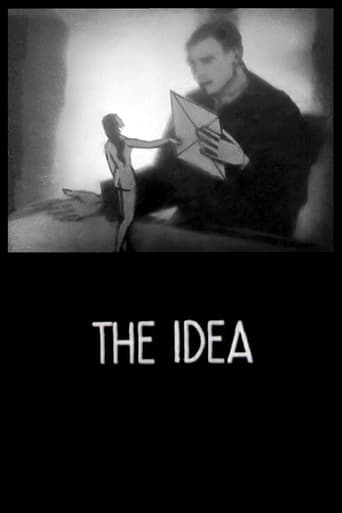
The Idea (1932)
L'idée
"Bartosch showed that animation could be poetic... It was Bartosch who first dared to give animation the dimension of a great art, trusting it to voice his pain, to lay bare his heart, to tell of his hope for a better future - which he never saw." - Alexander Alexeieff and Claire Parker, 1969
- Date of release
- 1932-12-31
- TMDB
- 6.0 / 10 (29)
- Runtime
- 25m
- Genres
- Animation
- Director
- Berthold Bartosch
Interesting facts
- Based on: The Idea
The Idea is a 1932 French animated film by Austro-Hungarian filmmaker Berthold Bartosch (1893–1968), based on the 1920 wordless novel of the same name by Flemish artist Frans Masereel (1889–1972). The protagonist is a naked woman who represents a thinker's idea; as she goes out into the world, the frightened authorities unsuccessfully try to cover up her nudity. A man who stands up for her is executed, and violent suppression by big business greets a workers' revolution she inspires.
Production
Production took years in a space over the Théâtre du Vieux-Colombier. The film required 45,000 frames of up to four levels of animation each on layers of glass plate, and up to eighteen camera superimpositions. Bartosch combined drawings with hinged cardboard cutout characters. The layered approach exposures took considerable time with Bartosch's limited resources—the room was lit only with a few 100-watt bulbs.
At first the two artists attempted an "animated woodcut" approach, but by March 1931 had rejected it in favour of a "more pictorial" one. Masereel found animation work tedious and backed out partway through; Bartosch finished the production in mid-1932. He combined and synthesized various animation techniques he had learned over his career and developed new ones such as blurring back-lit images with soap.
Read on Wikipedia · Text from Wikipedia, CC BY-SA 4.0. Data from Wikidata.
Recommended
- The Yankee Doodle Mouse 1943 · ★ 7.2
- Mickey's Grand Opera 1936 · ★ 6.5
- Solid Serenade 1946 · ★ 7.4
- The Big Bad Wolf 1934 · ★ 6.5
- The Night Before Christmas 1933 · ★ 6.4
- The Country Cousin 1936 · ★ 6.5
- Hockey Homicide 1945 · ★ 7.0
- The Art of Skiing 1941 · ★ 7.0
- Memorable 2019 · ★ 8.2
- The Pointer 1939 · ★ 6.1
- Donald's Nephews 1938 · ★ 6.5
- Donald and Pluto 1936 · ★ 6.7