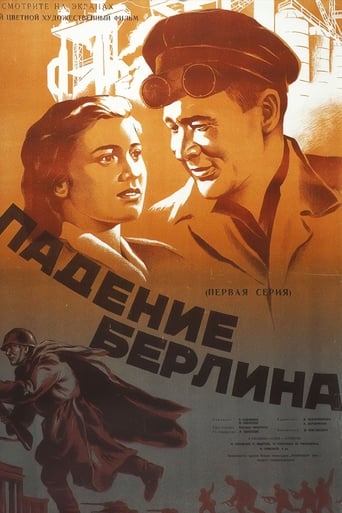
Падение Берлина (1950)
Surrounded by a few party officials, Alexei Ivanov, a stakhanovist smelter, is decorated by Stalin. The "Little Father of the Peoples" takes this opportunity to invoke threats of war.... One day, war indeed breaks out. Bombs fall on the field where Alexei finds himself in the company of the schoolmistress Natacha, his fiancée. Alexei joins the Red Army and soon becomes a sergeant. Fighting rages and German troops advance. Natacha is arrested and deported. But the tide turns decisively with the German defeat at Stalingrad. Now the major offensive against Hitler can begin.
- 개봉일
- 1950-01-21
- TMDB
- 5.0 / 10 (16)
- 장르
- 드라마, 전쟁
- 감독
- მიხეილ ჭიაურელი
출연진
- Михаил Геловани — I. V. Stalin
- Максим Штраух — Molotov
- Алексей Грибов — Voroshilov
- Николай Рыжов — Kaganovich
- Gavriil Belov — Kalinin
- Ruben Simonov — Mikoyan
- Г. Пасечник — Malenkov
- Владимир Любимов — Marshal Vasilyevsky
- Сергей Блинников — Marshal Konev
- Борис Ливанов — Marshal Rokossovsky
- Fyodor Blazhevich — Marshal Zhukov
- Константин Барташевич — General Sokolovsky
흥미로운 사실
The Fall of Berlin is a 1950 Soviet two-part epic war and propaganda film. It was produced by Mosfilm Studio and directed by Mikheil Chiaureli, from a screenplay he co-wrote with Pyotr Pavlenko, and a musical score composed by Dmitri Shostakovich. Portraying the history of the Second World War with a focus on a highly positive depiction of the role Soviet leader Joseph Stalin played in the events, it is considered one of the most important manifestations of Stalin's cult of personality, and a noted example of Soviet realism. After De-Stalinization, the film was banned in the Eastern Bloc for several decades.
Production
Stalin's cult of personality, which began to manifest itself already in the late 1930s, was marginalized during World War II; to mobilize the population against the enemy, Soviet films focused on historical heroes who defended Russia or on the feats of the people themselves. The premier's character appeared in only two pictures during the war.
Mikheil Chiaureli, Stalin's favorite director, and writer Pyotr Pavlenko had already collaborated to create the 1946 personality cult picture The Vow. The Soviet Minister of Cinema, Ivan Bolshakov, instructed them both to begin work on The Fall of Berlin shortly after the release of The Vow in July 1946. The film was conceived as the Mosfilm studio's gift to Stalin for his official 70th birthday, which was to be held on 21 December 1949.
As with all films in which his character made an appearance, Stalin took a keen interest in the work on The Fall of Berlin. The dictator intervened in Pavlenko's writing, read the screenplay's manuscript and corrected several grammatical mistakes; he also deleted a short sequence during which a German civilian in Berlin exhorted his family to hasten and flee as the Red Army approaches.
Edvard Radzinsky claimed his father heard from Pavlenko that Beria told him The Vow was to be a "sublime film", intended to identify Stalin with Jesus: Lenin, paralleling John the Baptist, recognized him as the Messiah; "this seminarist's language betrayed the authorship of this observation". Radzinsky added The Fall of Berlin "further developed the theme", as it ends "with an apotheosis: Stalin arrives by plane...
According to the memories of Svetlana Aliluyeva, Chiaureli approached her father with the idea to combine the fate of his son, Yakov Dzhugashvili, in the plot. Stalin promptly rejected this. Soviet actor Artyom Karapetian claimed Chiaureli's wife, actress Veriko Anjaparidze, told him Stalin was so outraged when he heard of this that Lavrentiy Beria – who was standing nearby – reached into his trousers' pocket, "presumably, for his gun." The direc…
위키백과에서 더 읽기 · 텍스트 출처: 위키백과, CC BY-SA 4.0. 데이터 출처: Wikidata.
추천
- AK-47 2020 · ★ 7.5
- 그들은 조국을 위해 싸웠다 1975 · ★ 6.9
- 비스트 1988 · ★ 7.1
- 고스트 스나이퍼 2021 · ★ 5.9
- 파일럿: 배틀 포 서바이벌 2021 · ★ 6.5
- 철십자 훈장 1977 · ★ 7.1
- 제 9중대 2005 · ★ 6.6
- 에너미 앳 더 게이트 2001 · ★ 7.4
- 1942: 최정예특수부대 스페츠나츠 2015 · ★ 6.8
- 미션 스카이 2021 · ★ 7.9
- 디보션 2022 · ★ 7.0
- 럭키 스트라이크 2026 · ★ 6.6