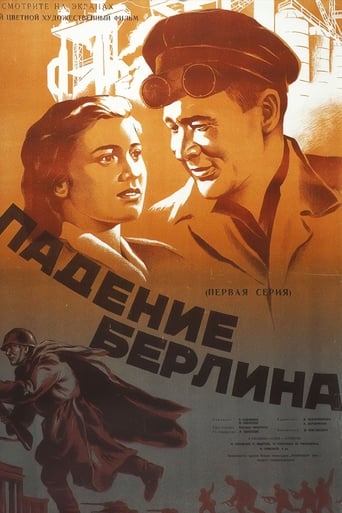
攻克柏林 (1950)
Падение Берлина
米哈依尔·齐阿乌列里(Mikheil Chiaureli)是斯大林的御用导演,由他执导的这部战争史诗《攻克柏林》长达近三个小时,分上下两部,处处着重突出最高统帅的高瞻远瞩。影片结尾,斯大林乘飞机抵达陷落的柏林,接受苏军的欢呼。其实这是“艺术虚构”。和《斯大林格勒战役》(www.douban.com/subject/1790606/)一样,尽管这场战役实际主要由朱可夫将军指挥,但影片中丝毫没有他的影子。当时朱可夫已经因为功高震主,被罗织罪名,发配到乌拉尔军区去了,这是1946年的事。这部1949年的电影很自然地就将朱可夫的功劳“艺术虚构”到伟大领袖的头上了。 因为这部影片,齐阿乌列里导演连续获得了两次国家奖金,包括1950年的斯大林奖金。中国观众熟悉的《难忘的1919》(www.douban.com/subject/1790597/)也出自这位导演的手笔。值得一提的是,这两部影片都是由苏联作曲家肖斯塔科维奇谱曲的。
- 上映日期
- 1950-01-21
- TMDB
- 5.0 / 10 (16)
- 类型
- 剧情, 战争
- 导演
- მიხეილ ჭიაურელი
演员阵容
- Михаил Геловани — I. V. Stalin
- Максим Штраух — Molotov
- Алексей Грибов — Voroshilov
- Николай Рыжов — Kaganovich
- Gavriil Belov — Kalinin
- Ruben Simonov — Mikoyan
- Г. Пасечник — Malenkov
- Владимир Любимов — Marshal Vasilyevsky
- Сергей Блинников — Marshal Konev
- Борис Ливанов — Marshal Rokossovsky
- Fyodor Blazhevich — Marshal Zhukov
- Константин Барташевич — General Sokolovsky
趣闻
The Fall of Berlin is a 1950 Soviet two-part epic war and propaganda film. It was produced by Mosfilm Studio and directed by Mikheil Chiaureli, from a screenplay he co-wrote with Pyotr Pavlenko, and a musical score composed by Dmitri Shostakovich. Portraying the history of the Second World War with a focus on a highly positive depiction of the role Soviet leader Joseph Stalin played in the events, it is considered one of the most important manifestations of Stalin's cult of personality, and a noted example of Soviet realism. After De-Stalinization, the film was banned in the Eastern Bloc for several decades.
Production
Stalin's cult of personality, which began to manifest itself already in the late 1930s, was marginalized during World War II; to mobilize the population against the enemy, Soviet films focused on historical heroes who defended Russia or on the feats of the people themselves. The premier's character appeared in only two pictures during the war.
Mikheil Chiaureli, Stalin's favorite director, and writer Pyotr Pavlenko had already collaborated to create the 1946 personality cult picture The Vow. The Soviet Minister of Cinema, Ivan Bolshakov, instructed them both to begin work on The Fall of Berlin shortly after the release of The Vow in July 1946. The film was conceived as the Mosfilm studio's gift to Stalin for his official 70th birthday, which was to be held on 21 December 1949.
As with all films in which his character made an appearance, Stalin took a keen interest in the work on The Fall of Berlin. The dictator intervened in Pavlenko's writing, read the screenplay's manuscript and corrected several grammatical mistakes; he also deleted a short sequence during which a German civilian in Berlin exhorted his family to hasten and flee as the Red Army approaches.
Edvard Radzinsky claimed his father heard from Pavlenko that Beria told him The Vow was to be a "sublime film", intended to identify Stalin with Jesus: Lenin, paralleling John the Baptist, recognized him as the Messiah; "this seminarist's language betrayed the authorship of this observation". Radzinsky added The Fall of Berlin "further developed the theme", as it ends "with an apotheosis: Stalin arrives by plane...
According to the memories of Svetlana Aliluyeva, Chiaureli approached her father with the idea to combine the fate of his son, Yakov Dzhugashvili, in the plot. Stalin promptly rejected this. Soviet actor Artyom Karapetian claimed Chiaureli's wife, actress Veriko Anjaparidze, told him Stalin was so outraged when he heard of this that Lavrentiy Beria – who was standing nearby – reached into his trousers' pocket, "presumably, for his gun." The direc…
在维基百科阅读更多 · 文本来自维基百科,CC BY-SA 4.0。数据来自 Wikidata。