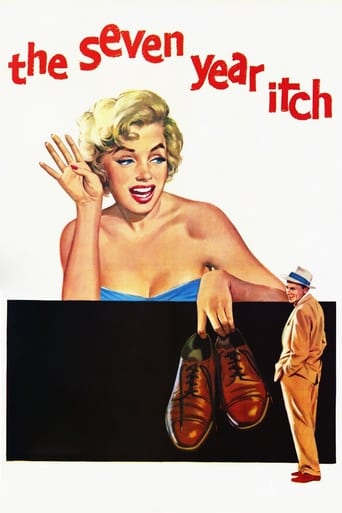
The Seven Year Itch (1955)
It TICKLES and TANTALIZES! - The funniest comedy since laughter began!
When his family goes away for summer vacation, a hitherto faithful publishing executive with an overactive imagination is tempted by an attractive new neighbor.
- Date of release
- 1955-06-03
- TMDB
- 7.0 / 10 (1046)
- Runtime
- 1h 45m
- Genres
- Comedy, Romance
- Director
- Billy Wilder
Casting
- Marilyn Monroe — The Girl
- Tom Ewell — Richard Sherman
- Evelyn Keyes — Helen Sherman
- Sonny Tufts — Tom MacKenzie
- Robert Strauss — M. Kruhulik
- Oskar Homolka — Dr. Brubaker
- Marguerite Chapman — Miss Morris
- Victor Moore — Plumber
- Dolores Rosedale — Elaine
- Donald MacBride — Mr. Brady
- Carolyn Jones — Miss Finch
- Brandon Beach — Commuter at Station (uncredited)
Interesting facts
- Box office: $12M
- Budget: $1.8M
- Earned 6.7× its budget
- Based on: The Seven Year Itch
- Filmed in: New York City
- Awards: 1 · Nominations: 0. Including: Golden Globe Award for Best Actor – Motion Picture Musical or Comedy
The Seven Year Itch is a 1955 American romantic comedy film directed by Billy Wilder, who co-wrote the screenplay with George Axelrod. Based on Axelrod's 1952 play, the film stars Marilyn Monroe and Tom Ewell, with the latter reprising his stage role. It contains one of the most iconic pop culture images of the 20th century, in the form of Monroe standing on a subway grate as her white dress is blown upwards by a passing train. The titular phrase, which refers to waning interest in a monogamous relationship after seven years of marriage, has been used by psychologists.
Production
The Seven Year Itch was filmed between September and November 1954 and is Wilder's only film released by 20th Century-Fox. The characters of Elaine (Dolores Rosedale), Marie, and the inner voices of Sherman and The Girl were dropped from the play; the characters of the Plumber, Miss Finch (Carolyn Jones), the Waitress (Doro Merande), and Kruhulik the janitor (Robert Strauss) were added.
Axelrod and Wilder complained that the film was being made under straitjacketed conditions. This led to a major plot change: in the play, Sherman and The Girl have sex; in the movie, the romance is reduced to suggestion; Sherman and The Girl kiss three times, once while playing Sherman's piano together, once outside the movie theater and once near the end before Sherman goes to take Ricky's paddle to him.
Saul Bass created the abstract title sequence, which was mentioned favorably in numerous reviews; up until that time, it was unheard of for trade press reviews to mention film title sequences.
Monroe's then-husband, famed baseball player Joe DiMaggio, was on set during the filming of the dress scene, and reportedly angry and disgusted with the attention she received from onlookers, reporters, and photographers in attendance.
Wilder had invited the media to drum up interest in the film.
Read on Wikipedia · Text from Wikipedia, CC BY-SA 4.0. Data from Wikidata.
Recommended
- That Uncertain Feeling 1941 · ★ 6.6
- Bluebeard's Eighth Wife 1938 · ★ 7.0
- Everyone Says I Love You 1996 · ★ 6.5
- Addicted to Love 1997 · ★ 6.2
- She's Funny That Way 2015 · ★ 5.9
- The Other Woman 2014 · ★ 6.4
- Keeping the Faith 2000 · ★ 6.1
- The Break-Up 2006 · ★ 5.9
- It's Complicated 2009 · ★ 6.5
- 5 to 7 2014 · ★ 7.1
- Little Italy 2018 · ★ 6.6
- One Small Hitch 2013 · ★ 6.6