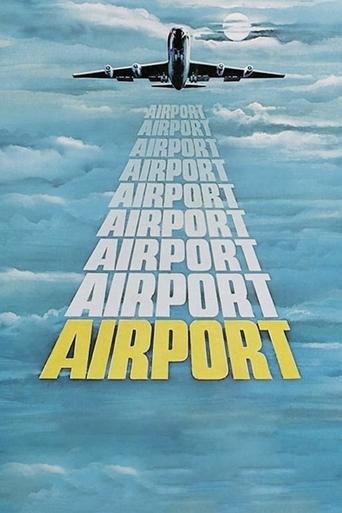
Airport (1970)
The #1 novel of the year - now a motion picture!
An airport manager tries to keep his terminals open during a snowstorm, while a suicide bomber plots to blow up a Boeing 707 airliner in flight.
- Date of release
- 1970-03-25
- TMDB
- 6.5 / 10 (485)
- Runtime
- 2h 17m
- Genres
- Drama, Thriller, Action
- Director
- George Seaton
- Collection
- Airport Collection
Casting
- Burt Lancaster — Mel Bakersfeld
- Dana Wynter — Cindy Bakersfeld
- Dean Martin — Vernon Demerest
- Barbara Hale — Sarah Demerest
- Jean Seberg — Tanya Livingston
- Jacqueline Bisset — Gwen Meighen
- George Kennedy — Joe Patroni
- Jodean Lawrence — Marie Patroni
- Helen Hayes — Ada Quonsett
- John Findlater — Peter Coakley
- Van Heflin — D. O. Guerrero
- Maureen Stapleton — Inez Guerrero
Interesting facts
- Box office: $128.4M
- Budget: $10M
- Earned 12.8× its budget
- Based on: Airport
- Awards: 1 · Nominations: 10. Including: Academy Award for Best Supporting Actress
Airport is a 1970 American disaster film written and directed by George Seaton, and distributed by Universal Pictures. Based on Arthur Hailey's 1968 novel, it originated the 1970s disaster film genre, and is the first of four films in the Airport film series. It features an ensemble cast of performers, led by Burt Lancaster and Dean Martin, and featuring Jean Seberg, Jacqueline Bisset, George Kennedy, Helen Hayes, Van Heflin, Maureen Stapleton, Barry Nelson, Lloyd Nolan, Dana Wynter and Barbara Hale.
Production
Most of the filming was at Minneapolis–Saint Paul International Airport, which was redressed as the fictional Lincoln International Airport. A display in the terminal, with stills from the field and the film, says: "Minnesota's legendary winters attracted Hollywood here in 1969, when portions of the film Airport were shot in the terminal and on the field.
George Seaton caught pneumonia Christmas Day in 1968 and Henry Hathaway took over directing while Seaton recovered, directing most of the exteriors; despite shooting for five weeks, Hathaway elected for no payment or screen credit.
The expensive set built representing the full interior of the 707 was left standing at Universal Studios, and was eventually joined with a more expensive airliner set, the front half of a 747-interior constructed in 1974 for Airport 1975. These two sets became known as "Stage 747" on the lot, and both sets were used extensively in other Universal films and television series.
Only one Boeing 707 was used: a model 707-349C (registration N324F) leased from Flying Tiger Line. It sported an El Al cheatline over its bare metal finish, with the fictional Trans Global Airlines (TGA) titles and tail. This aircraft later crashed on March 21, 1989, during approach into São Paulo while in service as cargo flight Transbrasil Flight 801, killing all three crew members and 22 people on the ground.
The film was the final project for composer Alfred Newman. His health was failing and he was unable to conduct the sessions for his music's recording. The job was handled by Stanley Wilson, although the covers of the Decca "original soundtrack album" and the 1993 Varèse Sarabande CD issue credit Newman. Newman did conduct the music heard in the film. He died before the film's release.
Read on Wikipedia · Text from Wikipedia, CC BY-SA 4.0. Data from Wikidata.
Recommended
- Skyjacked 1972 · ★ 6.2
- Meltdown: Days of Destruction 2006 · ★ 6.0
- Sabotage 1936 · ★ 6.7
- Fail Safe 2000 · ★ 6.8
- Flight of the Phoenix 2004 · ★ 6.0
- Bear Island 1979 · ★ 6.0
- Gray Lady Down 1978 · ★ 6.5
- By Dawn's Early Light 1990 · ★ 6.5
- 13 Minutes 2021 · ★ 5.8
- The Caveman's Valentine 2001 · ★ 5.9
- The Parts You Lose 2019 · ★ 6.6
- North Sea Hijack 1980 · ★ 6.3