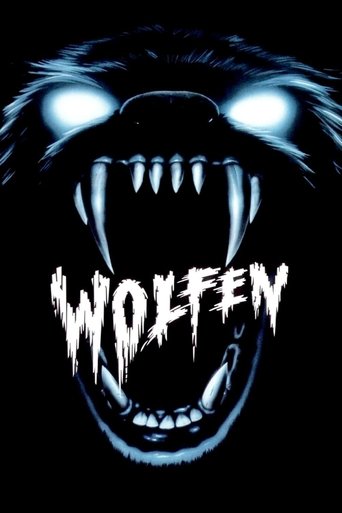
Wolfen (1981)
They can hear a cloud pass overhead, the rhythm of your blood. They can track you by yesterday's shadow. They can tear the scream from your throat.
A New York City cop and an expert criminologist trying to solve a series of grisly deaths in which the victims have seemingly been maimed by feral animals discover a sinister connection between the crimes and an old legend.
- Date of release
- 1981-07-24
- TMDB
- 5.9 / 10 (271)
- Runtime
- 1h 55m
- Genres
- Horror, Thriller
- Director
- Michael Wadleigh
Casting
- Albert Finney — Dewey Wilson
- Diane Venora — Rebecca Neff
- Edward James Olmos — Eddie Holt
- Gregory Hines — Whittington
- Tom Noonan — Ferguson
- Dick O'Neill — Warren
- Dehl Berti — Old Indian
- Peter Michael Goetz — Ross
- Sam Gray — Mayor
- Ralph Bell — Commissioner
- Max M. Brown — Christopher van der Veer
- Anne Pohtamo — Pauline van der Veer
Interesting facts
- Box office: $10.6M
- Budget: $17M
- Earned 0.6× its budget
- Based on: The Wolfen
- Filmed in: New York City
Wolfen is a 1981 American crime horror film directed by Michael Wadleigh in his second directorial feature film, based on Whitley Strieber's 1978 novel The Wolfen. It stars Albert Finney, Diane Venora, Gregory Hines and Edward James Olmos. The film follows city-cop Detective Dewey Wilson who has been assigned to uncover what is behind a series of vicious murders. Originally, it is believed the murders are animal attacks until Wilson discovers an indigenous legend about wolf-spirits.
Production
The film is known for its early use of an in-camera effect to portray the subjective point of view of a wolf. Similar to thermography, the technique was later adopted by other horror films such as the Predator film series. The setting for the transient home of the wolves was shot in the South Bronx (intersection of Louis Niñé Boulevard and Boston Road).
The church seen in the opening panorama shot was located at the intersection of E. 172nd Street and Seabury Place. The shot of this neighbourhood is from the north looking roughly south-south-east. The decrepit site of ruined buildings was no special effect; the church was built and burned exclusively for the film. Urban decay in the South Bronx in the early 1980s was so widespread that it was the ideal production setting.
Dustin Hoffman was interested in portraying the role of Dewey Wilson but Michael Wadleigh insisted on Albert Finney. According to Roger Ebert, the film was originally to have been distributed by United Artists. With claims of being overbudget and being over schedule, Orion Pictures tried to have Wadleigh fired.
Read on Wikipedia · Text from Wikipedia, CC BY-SA 4.0. Data from Wikidata.
Recommended
- The Wolf of Snow Hollow 2020 · ★ 6.1
- The Believers 1987 · ★ 5.9
- The Howling 1981 · ★ 6.6
- Sleepwalkers 1992 · ★ 6.1
- God Told Me To 1976 · ★ 5.9
- The Hound of the Baskervilles 1939 · ★ 7.1
- The Bone Collector 1999 · ★ 6.8
- The Pale Blue Eye 2022 · ★ 6.8
- The Woman in the Window 2021 · ★ 6.0
- A Return to Salem's Lot 1987 · ★ 6.0
- Dark Harvest 2023 · ★ 6.1
- The Sentinel 1977 · ★ 6.1