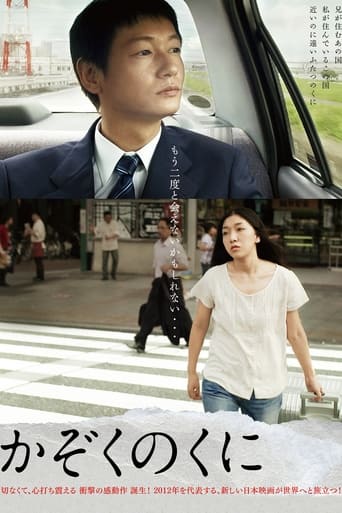
かぞくのくに (2012)
From the late 1950s through the '70s, more than 90,000 of the ethnic Koreans in Japan emigrated to North Korea, a country that promised them affluence, justice, and an end to discrimination. KAZOKU NO KUNI tells the story of one of their number, who returns for just a short period. For the first time in 25 years, Sonho is reunited with his family in Tokyo after being allowed to undergo an operation there. Sonho’s younger sister Rie is at the centre of the film, and is not hard to recognise as the director’s alter-ego. In her documentaries DEAR PYONGYANG and SONA, THE OTHER MYSELF, Yang Yonghi told the story of her own life, and how, at age six, she experienced the departure of her three older brothers, who left their family for Pyongyang.
- Data di uscita
- 2012-07-01
- TMDB
- 6.0 / 10 (16)
- Durata
- 1 h 40 min
- Generi
- Dramma
- Regista
- Yang Yong-hi
Cast
- Sakura Ando — Rie
- Arata Iura — Sonho
- 大森立嗣 — Hongi
- 양익준 — Mr. Yang
- Jun Murakami — Juno
- 京野ことみ — Suni
- 宮崎美子 — Mother
- 津嘉山正種 — Father
- 諏訪太朗 — Uncle Tejo
Curiosità
- Premi: 0 · Candidature: 1
Our Homeland is a 2012 Japanese drama film about a Korean man's visit to his family in Japan after a long exile in North Korea. This is the feature directorial debut of Yang Yong-hi, a second-generation ethnic Korean living in Japan who based the film on her family history. The film was selected as the Japanese entry for the Best Foreign Language Oscar at the 85th Academy Awards, but it did not make the final shortlist.
Leggi su Wikipedia · Testo da Wikipedia, CC BY-SA 4.0. Dati da Wikidata.
Consigliati
- Minari 2020 · ★ 7.3
- Tre desideri 1995 · ★ 6.3
- Padri e figlie 2015 · ★ 7.2
- Il pasto 1951 · ★ 7.6
- Normal 2003 · ★ 6.7
- To the Ends of the Earth 2019 · ★ 6.3
- Blue Heron 2026 · ★ 6.5
- Reality 2023 · ★ 6.4
- Ritratto di famiglia con tempesta 2016 · ★ 7.2
- Home 2021 · ★ 6.7
- Tarda primavera 1949 · ★ 8.0
- Her Love Boils Bathwater 2016 · ★ 7.4