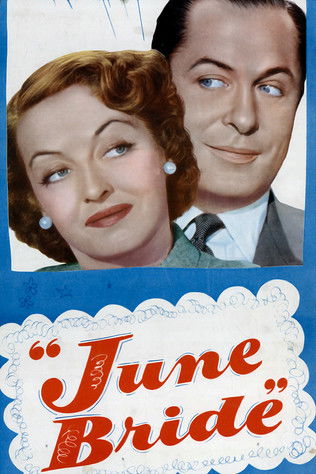
June Bride (1948)
Warner Bros. new laugh team in the happiest hit of their lives!!!
A magazine's staff, including bickering ex-lovers Linda and Carey, cover an Indiana wedding, which goes slightly wrong.
- Date of release
- 1948-10-29
- TMDB
- 7.1 / 10 (12)
- Runtime
- 1h 36m
- Genres
- Romance, Comedy
- Director
- Bretaigne Windust
Casting
- Bette Davis — Linda Gilman
- Robert Montgomery — Carey Jackson
- Fay Bainter — Paula Winthrop
- Betty Lynn — Barbara 'Boo' Brinker
- Tom Tully — Mr. Whitman Brinker
- Barbara Bates — Jeanne Brinker
- Jerome Cowan — Carleton Towne
- Mary Wickes — Rosemary McNally
- Debbie Reynolds — Boo's Girlfriend at Wedding
- Marjorie Bennett — Nellie Brinker
- Raymond Roe — Bud Mitchell
- Ray Montgomery — Jim Mitchell
Interesting facts
June Bride is a 1948 American comedy film directed by Bretaigne Windust. The screenplay, which was based on the unproduced play Feature for June by Eileen Tighe and Graeme Lorimer, was nominated for the Writers Guild of America Award for Best Written American Comedy. The film starred Bette Davis and Robert Montgomery. The Warner Bros. Pictures release marked the screen debut of Debbie Reynolds, although her appearance was uncredited.
Production
Paramount Pictures also considered producing a film version of Tighe and Lorimer's play which Tighe, the editor of House and Garden, had considered adapting into a stage musical.
Bette Davis wanted either Dennis Morgan or Jack Carson for her co-star, but director Windust and producer Henry Blanke convinced her to accept Robert Montgomery as her leading man, arguing he had a larger fan base. Blanke later admitted they believed the mid-forties Montgomery would make 40-year-old Davis look younger, but after watching the rushes, he realized the casting achieved the opposite effect, with Davis making Montgomery look younger.
June Bride was filmed during the 1948 Presidential campaign. A line of dialogue delivered by Mary Wickes referring to the desperately-needed refurbishment of the old-fashioned Brinker home, a dowdy house crammed full of Victoriana kitsch, was filmed twice, once as "How can I convert this McKinley stinker into a Dewey modern?" and the second time with the name Truman substituted for Dewey.
The film's success proved to be an oasis for Davis and Warner Brothers; her previous two pictures were box-office disappointments. It was the first comedy film Davis had made since 1941. In that year, she starred in two comedies: The Bride Came C.O.D. and The Man Who Came to Dinner. As a result, Davis was given a new, four-picture contract with a salary of $10,285 a week, making her the highest-paid woman in the United States at the time.
Davis reprised her role of Linda Gilman in an August 29, 1949, Lux Radio Theatre broadcast co-starring James Stewart as Carey Jackson. Irene Dunne and Fred MacMurray assumed the roles in a second Lux adaptation on December 28, 1953, and Marguerite Chapman and Jerome Thor starred in a Lux Video Theatre telecast on August 25, 1955.
Read on Wikipedia · Text from Wikipedia, CC BY-SA 4.0. Data from Wikidata.
Recommended
- Runaway Bride 1999 · ★ 6.1
- Sweet Home Alabama 2002 · ★ 6.4
- Merry Matrimony 2015 · ★ 5.8
- It Happened One Night 1934 · ★ 7.8
- The Philadelphia Story 1940 · ★ 7.5
- The Wedding Planner 2001 · ★ 5.9
- Bride Wars 2009 · ★ 6.2
- 27 Dresses 2008 · ★ 6.5
- Libeled Lady 1936 · ★ 7.3
- Father of the Bride 1991 · ★ 6.5
- Guess Who 2005 · ★ 6.1
- Little Manhattan 2005 · ★ 7.2