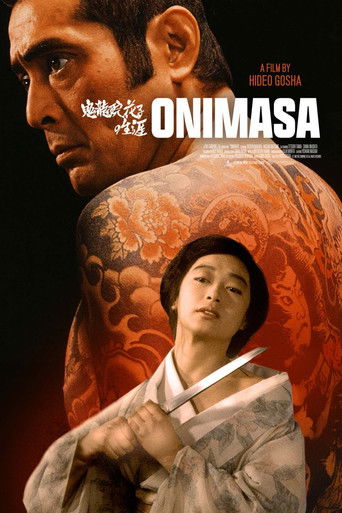
Onimasa: A Japanese Godfather (1982)
鬼龍院花子の生涯
Onimasa is the egocentric boss of a small yakuza clan on Shikoku Island, whose criminal duties conflict with his self-image as a chivalrous samurai. His struggles with his boss, the Shikoku Godfather, and the tumultuous life of his adopted daughter, Matsue, form the backdrop of this epic tale of justice, obedience, and bloody vengeance.
- Date of release
- 1982-06-05
- TMDB
- 6.2 / 10 (26)
- Runtime
- 2h 26m
- Genres
- Action, Crime, Drama
- Director
- Hideo Gosha
Casting
- Tatsuya Nakadai — Masagoro Kiryuin - Onimasa
- Masako Natsume — Matsue Kiryûin
- Shima Iwashita — Uta Kiryûin
- Tetsuro Tamba — Uichi Suda, The Big Boss
- Akiko Kana — Tsuru
- Emi Shindō — Emiwaka, 2nd Mistress
- Akiko Nakamura — Botan, 3rd Mistress
- Mari Natsuki — Akio, Opponent's Mistress
- Mikio Narita — Tokuhei Tsujihara
- Tatsuo Umemiya — Katsu Yamane
- Eitarō Ozawa — Genichiro Tanabe
- Isao Natsuyagi — Kanematsu
Interesting facts
- Awards: 0 · Nominations: 1
Onimasa, known in Japan as Kiryūin Hanako no Shōgai , is a 1982 Japanese yakuza film directed by Hideo Gosha. Based on Tomiko Miyao's 1980 novel Kiryūin Hanako no Shōgai. It was Japan's submission to the 55th Academy Awards for the Academy Award for Best Foreign Language Film, but was not accepted as a nominee.
Production
After seeing Tomiko Miyao's 1980 novel Kiryūin Hanako no Shōgai in a bookstore, actress Meiko Kaji wished to make a film adaptation. Imagining herself in the lead role of Matsue and Tomisaburo Wakayama as Onimasa, Kaji pitched the movie to Toei. After several months without hearing anything, Toei publicly announced that they would be adapting the novel.
Producer Goro Kusakabe described the events differently, stating that Kaji simply handed him the book and expressed interest in playing the lead in what was already a project under consideration for adaptation. He also explained that he decided against her playing Matsue because she was too mature for a role that followed a character from childhood to adulthood.
At the time, Hideo Gosha was struggling financially after suffering hardships in his personal and family life. A longtime fan of Miyao who wanted to adapt one of her works for some time, he got the job directing thanks to one of his friends suggesting Okada give him a comeback film. Shinobu Otake was offered the lead role of Matsue, but refused to work with Toei's Kyoto studio.
Filming was halted for a month while Natsume underwent thyroid surgery for Graves' disease.
Read on Wikipedia · Text from Wikipedia, CC BY-SA 4.0. Data from Wikidata.
Recommended
- Battles Without Honor and Humanity: Deadly Fight in Hiroshima 1973 · ★ 7.3
- Sympathy for the Underdog 1971 · ★ 7.1
- Outrage Coda 2017 · ★ 6.8
- Female Yakuza Tale 1973 · ★ 6.1
- Gonin 1995 · ★ 6.6
- The Yakuza 1974 · ★ 7.1
- Tokyo Fist 1995 · ★ 6.8
- Return of the Street Fighter 1974 · ★ 6.1
- The Enforcer 2022 · ★ 7.0
- Graveyard of Honor 2002 · ★ 6.3
- Agitator 2001 · ★ 6.4
- In Full Bloom 2019 · ★ 6.8