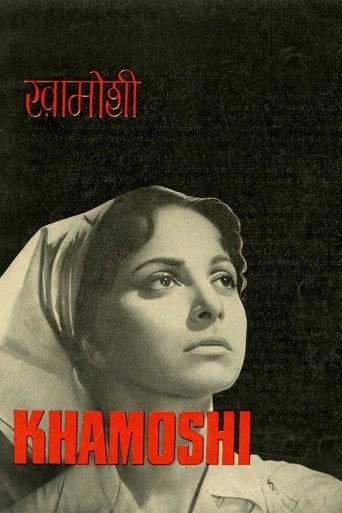
ख़ामोशी (1969)
Colonel Sahab is a doctor in a psychiatry ward and Nurse Radha (Waheeda Rahman) is heart-broken after a civilian patient, Dev Kumar (Dharmendra), whom she cared for, pouring out her love and affection, leaves the hospital, as she had been unable to keep her heart separate from her professional work and had fallen in love with her patient. Next Arun Choudury (Rajesh Khanna), a writer and poet enters as a patient, suffering acute mania after being rejected by his lover, Sulekha. After refusing to take his care, Radha relents and starts nursing him. In between while caring for Arun she reminisces her past and tells a story of how she took care of injured brave army soldiers when she was posted in Laddakh during the Sino-Indian war of 1962.
- Data di uscita
- 1969-04-25
- TMDB
- 9.0 / 10 (2)
- Durata
- 2 h 7 min
- Generi
- Romance, Dramma, Famiglia
- Regista
- Asit Sen
Cast
- Rajesh Khanna — Arun Choudhury (Patient #24)
- Waheeda Rehman — Nurse Radha
- Nazir Hussain — Dr. Colonel Saab
- Snehlata — Sulekha
- Iftekhar — Doctor
- Lalita Pawar — Matron
- Dharmendra — Mr. Dev (Patient #24) (Guest Appearance)
- Deven Verma — Patient #22
- Bhudo Advani
- Brahm Bhardwaj
- Tarun Ghosh
- Anwar Hussain — Biharilal Gupta
Curiosità
Khamoshi (transl. Silence) is a 1969 black-and-white Hindi drama film directed by Asit Sen, starring Waheeda Rehman and Rajesh Khanna. It is especially remembered for its memorable music by Hemant Kumar and lyrics by Gulzar in songs such as "Tum Pukaar Lo... Tumhara Intezaar Hai" sung by Hemant Kumar, "Woh Shaam Kuch Ajeeb Thi" by Kishore Kumar and "Humne Dekhi Hai In Aankhon Ki Mehekti Khushboo" sung by Lata Mangeshkar. Though what really made this film stand out was the B&W cinematography by Kamal Bose, who won Best Cinematographer at the 18th Filmfare Awards for his work in the film and received high critical acclaim for Rehman and Khanna's performances.
Background
Director Asit Sen (not to be confused with the actor-comedian Asit Sen) acted in the original Bengali film Deep Jwele Jaai (1959) in a role which was essayed by Dharmendra in Khamoshi. The movie-goers did not recognise Asit Sen in the film, because it was a dark scene marked with the baritone voice of Hemant Kumar. The director revealed this in an interview in the 1990s.
The lead actress of the film, Waheeda Rehman suggested the name of actor Rajesh Khanna to Sen, having been impressed by his work in Aakhri Khat (1966). She said that her own performance came "nowhere near that of Suchitra Sen in the original." She credited the director for helping her a lot during difficult scenes. Rehman said in an interview that she could not meet the standards set by Savitri in Chivaraku Migiledi (1960) for the character.
Leggi su Wikipedia · Testo da Wikipedia, CC BY-SA 4.0. Dati da Wikidata.
Consigliati
- Skater Girl 2021 · ★ 7.2
- Senza zucchero 2007 · ★ 6.1
- Where the Red Fern Grows 2003 · ★ 6.6
- Parineeta 2005 · ★ 6.5
- Dhadkan 2000 · ★ 6.4
- Departure 2016 · ★ 6.3
- Jab Tak Hai Jaan 2012 · ★ 7.0
- Heidi 2005 · ★ 7.8
- Sir - Cenerentola a Mumbai 2018 · ★ 7.1
- Christmas Cottage 2008 · ★ 6.3
- Dove cresce la felce rossa 1974 · ★ 6.9
- Salomè 1953 · ★ 5.8