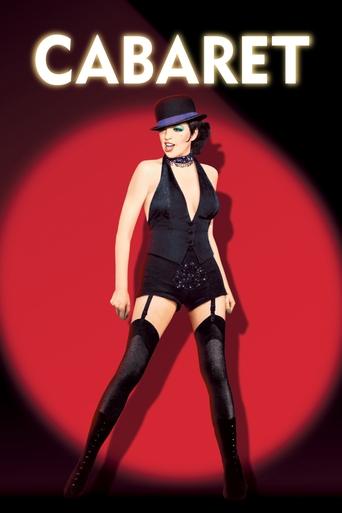
Cabaret (1972)
Life is a Cabaret.
Inside the Kit Kat Club of 1931 Berlin, starry-eyed singer Sally Bowles and an impish emcee sound the clarion call to decadent fun, while outside a certain political party grows into a brutal force.
- Date of release
- 1972-02-13
- TMDB
- 7.4 / 10 (1033)
- Runtime
- 2h 4m
- Genres
- Music, Romance, Drama
- Director
- Bob Fosse
Casting
- Liza Minnelli — Sally Bowles
- Michael York — Brian Roberts
- Helmut Griem — Maximilian von Heune
- Joel Grey — Master of Ceremonies
- Fritz Wepper — Fritz Wendel
- Marisa Berenson — Natalia Landauer
- Elisabeth Neumann-Viertel — Fräulein Schneider
- Helen Vita — Fräulein Kost
- Sigrid von Richthofen — Fräulein Mayr
- Gerd Vespermann — Bobby
- Ralf Wolter — Herr Ludwig
- Georg Hartmann — Willi
Interesting facts
- Box office: $41.4M
- Budget: $4.6M
- Earned 9× its budget
- Based on: Cabaret
- Awards: 11 · Nominations: 10. Including: Silver nugget for the best foreign film; Academy Award for Best Supporting Actor; Academy Award for Best Actress; Academy Award for Best Director
Cabaret is a 1972 American musical drama film directed and choreographed by Bob Fosse from a screenplay by Jay Presson Allen. It is based on the 1966 stage musical by Joe Masteroff (book) and the duo Kander and Ebb (music), which in turn was based on the 1951 play I Am a Camera by John Van Druten and the 1939 novel Goodbye to Berlin by Christopher Isherwood. It stars Liza Minnelli, Michael York, Helmut Griem, Marisa Berenson, and Joel Grey. The film won eight Academy Awards, including Best Director for Fosse, Best Actress for Minnelli, and Best Supporting Actor for Grey.
Production
In July 1968, Cinerama made a verbal agreement to make a film version of the 1966 Broadway musical but pulled out in February 1969. In May 1969, Allied Artists paid a company record $1.5 million for the film rights and planned a company record budget. The cost of $4,570,000 was split evenly with ABC Pictures.
In 1971, Bob Fosse learned through Harold Prince, director of the original Broadway production, that Cy Feuer was producing a film adaptation of Cabaret through ABC Pictures and Allied Artists. It would be one of the last movies made by ABC. This was the first film produced in the revival of Allied Artists. Determined to direct the film, Fosse begged Feuer to hire him.
Eager to hire Fosse, Feuer appealed to the studio heads, citing Fosse's talent for staging and shooting musical numbers, adding that if inordinate attention was given to filming the book scenes at the expense of the musical numbers, the whole film could fail. Fosse ultimately was hired. Over the next months, Fosse met with previously hired screenwriter Jay Presson Allen to discuss the screenplay.
As production neared, Fosse became increasingly dissatisfied with Allen's script, which was based on Joe Masteroff's original book of the stage version. Fosse hired Hugh Wheeler to rewrite and revise Allen's work. Wheeler was referred to as a "research consultant," and Allen retained screenwriting credit.
Fosse decided to increase the focus on the Kit Kat Klub, where Sally performs, as a metaphor for the decadence of Germany in the 1930s by eliminating all but one of the musical numbers performed outside the club. The only remaining outside number is "Tomorrow Belongs to Me", a folk song rendered spontaneously by patrons at an open-air café.
Read on Wikipedia · Text from Wikipedia, CC BY-SA 4.0. Data from Wikidata.
Recommended
- Bent 1997 · ★ 6.8
- The Wedding March 1928 · ★ 7.2
- House of Boys 2009 · ★ 6.2
- Maestro 2023 · ★ 6.2
- Ma Rainey's Black Bottom 2020 · ★ 6.6
- Lady Chatterley's Lover 2022 · ★ 6.7
- Pennies from Heaven 1981 · ★ 6.1
- Behind the Candelabra 2013 · ★ 6.6
- All Over Me 1997 · ★ 5.9
- Total Eclipse 1995 · ★ 6.4
- A Very Natural Thing 1974 · ★ 7.1
- Bessie 2015 · ★ 6.4