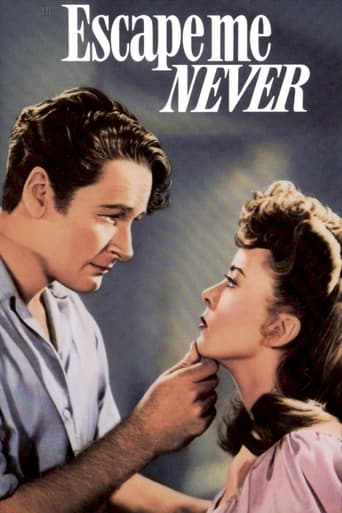
Nunca huyas de mí (1947)
Escape Me Never
Venecia 1900. Cuando Fenella se entera de que su prometido, el compositor Caryl Dubrok, está viviendo con Gemma, una madre soltera, rompe su compromiso. En un viaje a los Alpes conoce a otro compositor llamado Sebastian Dubrok; ignora que es el hermano de Caryl y el hombre con quien vive Gemma. Se enamora de él, pero no puede evitar que se case con Gemma. Al volver a Inglaterra, se compromete otra vez con Caryl, pero el ballet que le dedica Sebastian hará que no pueda olvidar su amor por él.
- Fecha de estreno
- 1947-11-07
- TMDB
- 4.8 / 10 (12)
- Duración
- 1 h 44 min
- Géneros
- Drama, Romance
- Director
- Peter Godfrey
Reparto
- Errol Flynn — Sebastian Dubrok
- Ida Lupino — Gemma Smith
- Eleanor Parker — Fenella MacLean
- Gig Young — Caryl Dubrok
- Reginald Denny — Mr. MacLean
- Isobel Elsom — Mrs. MacLean
- Albert Bassermann — Professor Heinrich
- Ludwig Stössel — Mr. Steinach
- Milada Mladova — Natrova
- Юрий Зорич — The Dancer
- Helene Thimig — The Landlady
- Frank Puglia — The Guide
Curiosidades
- Basada en: Escape Me Never y The Fool of the Family
Escape Me Never is a 1947 American melodrama film directed by Peter Godfrey, and starring Errol Flynn, Ida Lupino, Eleanor Parker, and Gig Young.
Production
The original play was first performed in England in 1933, and on Broadway in 1935. Elisabeth Bergner appeared on stage in a revival of the play in 1942.
In August 1943, Warner Bros. Pictures announced that they would make a film version of the play, as a follow-up to the popular The Constant Nymph. Leonore Coffee was reported as working on the script, with Henry Blanke to produce and Joan Leslie mentioned as a possible star.
Lupino and Flynn were announced for the film in September 1945, with Peter Godfrey attached to direct. Shooting started later that year. It was completed in February 1946.
Lupino sang two songs in the film. She was meant to be billed after Flynn and Parker, but protested and succeeded in being billed after Flynn.
This was the last film to be released with a complete musical score by Erich Wolfgang Korngold, who retired from composing for film in 1947.(Korngold did later adapt the music of Richard Wagner for Republic Pictures' 1955 biography of Wagner, Magic Fire; he wrote some original music for that film as well.)
Leer en Wikipedia · Texto de Wikipedia, CC BY-SA 4.0. Datos de Wikidata.
Recomendadas
- De amor también se muere 1947 · ★ 7.0
- Un extraño en mi vida 1960 · ★ 6.4
- Una vida nueva 2020 · ★ 6.6
- El secreto: Atrévete a soñar 2020 · ★ 7.4
- Carta de una desconocida 1948 · ★ 7.8
- Serenata nostálgica 1941 · ★ 6.6
- Intermezzo 1939 · ★ 6.7
- Mientras estés conmigo 2020 · ★ 7.6
- Sólo el cielo lo sabe 1955 · ★ 7.3
- La última primavera 2004 · ★ 6.4
- Love Story 1970 · ★ 6.8
- The Magic of Ordinary Days 2005 · ★ 7.5