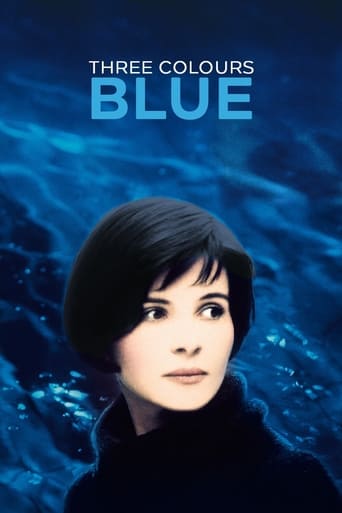
Three Colors: Blue (1993)
Trois couleurs : Bleu
The wife of a famous composer survives a car accident that kills her husband and daughter. Now alone, she shakes off her old identity and explores her newfound freedom but finds that she is unbreakably bound to other humans, including her husband’s mistress, whose existence she never suspected.
- Date of release
- 1993-09-08
- TMDB
- 7.6 / 10 (1996)
- Runtime
- 1h 38m
- Genres
- Drama
- Director
- Krzysztof Kieślowski
- Collection
- Three Colors Collection
Casting
- Juliette Binoche — Julie
- Benoît Régent — Olivier
- Florence Pernel — Sandrine
- Charlotte Véry — Lucille
- Hélène Vincent — Journalist
- Philippe Volter — Real Estate Agent
- Claude Duneton — Doctor
- Hugues Quester — Patrice (Julie's Husband)
- Emmanuelle Riva — Mother
- Florence Vignon — The Copyist
- Daniel Martin — The Downstairs Neighbour
- Jacek Ostaszewski — The Flutist
Interesting facts
- Box office: $1.4M
- Filmed in: Paris
- Awards: 2 · Nominations: 1. Including: Golden Lion; Guldbagge Award for Best Foreign Film
Three Colours: Blue is a 1993 psychological drama film co-written and directed by Polish filmmaker Krzysztof Kieślowski. It is the first instalment in the Three Colours trilogy, themed on the French Revolutionary ideals of liberty, equality and fraternity, followed by White and Red. According to Kieślowski, the subject of the film is liberty, specifically emotional liberty, rather than its social or political meaning.
Production
Blue was an international co-production between the French companies CED Productions, Eurimages, France 3 Cinéma, and MK2 Productions, the Swiss company CAB Productions and the Polish company Studio Filmowe TOR. Principal photography began on 7 September 1992 and completed shooting in October 1992.
Like the other films in the trilogy, Blue makes frequent visual allusions to its title: numerous scenes are shot with blue filters or blue lighting, and many objects are blue. When Julie thinks about the musical score that she has tried to destroy, blue light overwhelms the screen.
Read on Wikipedia · Text from Wikipedia, CC BY-SA 4.0. Data from Wikidata.
Recommended
- Birth 2004 · ★ 6.1
- The Past 2013 · ★ 7.2
- The Diving Bell and the Butterfly 2007 · ★ 7.6
- Premonition 2007 · ★ 6.3
- Nino 2025 · ★ 7.4
- Othello 1951 · ★ 7.4
- At Eternity's Gate 2018 · ★ 7.0
- Hamlet 1996 · ★ 7.3
- The Eternal Daughter 2022 · ★ 5.9
- The Starling 2021 · ★ 6.9
- Colette 2018 · ★ 6.9
- The Prodigal Daughter 1981 · ★ 7.0