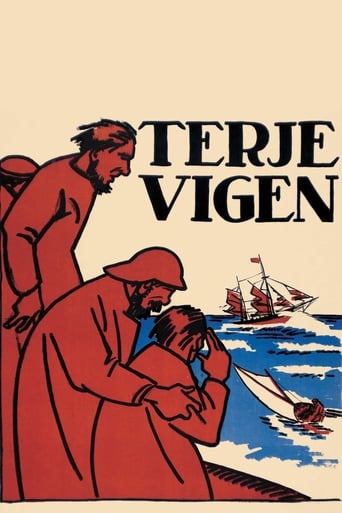
Terje Vigen (1917)
Terje Vigen, a sailor, suffers the loss of his family through the inflexibility of another man. Years later, when his enemy's family finds itself dependent on his benevolence, Terje must decide whether to avenge himself.
- Data de estreia
- 1917-01-29
- TMDB
- 7.1 / 10 (86)
- Duração
- 56 min
- Géneros
- Drama, História
- Realizador
- Victor Sjöström
Elenco
- Victor Sjöström — Terje Vigen
- Bergliot Husberg — Terje Vigens hustru
- August Falck — Den engelske lorden
- Edith Erastoff — Den engelska ladyn
- Eric Abrahamsson — En fiskare (uncredited)
- Hildur Carlberg — En kvinna i byn (uncredited)
- Gucken Cederborg — Den nya hustrun i Terjes stuga (uncredited)
- John Ekman — Norsk fånge i fängelset (uncredited)
- Nils Elffors — En av Terjes kamrater (uncredited)
- Emil Fjellström — En fiskare på stranden (uncredited)
- Herman Lantz — En av Terjes kamrater (uncredited)
- Jenny Tschernichin-Larsson — En kvinna på stranden (uncredited)
Curiosidades
- Baseado em: Terje Vigen
A Man There Was is a 1917 silent Swedish drama co-written and directed by Victor Sjöström, based on a poem of the same title by Henrik Ibsen. With a budget of SEK 60,000, it was the most expensive Swedish film made up to that point, marking a new direction in Swedish cinema with more funding to fewer films, resulting in better overall quality.
Production
In Grimstad, Norway, while working at a pharmacy, Henrik Ibsen would often listen to the stories of the Norse maritime pilots. He became a close friend to one of the oldest and most experienced pilots, who had lived a remarkable life and had exciting stories to tell the young writer. His name was Svend Hanssen Haaø, from the island of Haaø (in modern Norwegian Håøya).
Svend Hanssen Haaø's life contains many of the essential elements of the story of Terje Vigen. Haaø made several trips by rowboat to Denmark through the British blockade, in the years 1807–14, to smuggle food back to his family and friends in Grimstad. The British captured him as many as four times, and some of his crew were put in prison in England as in the poem.
Formerly, very reserved about the possibilities of adapting Henrik Ibsen's works to the screen, "Victor Sjostrom did not see how the style of the Norwegian author could be reconciled with the prevailing fashion for comedies and thrillers." Consequently, he did not immediately accede to the wishes expressed by Charles Magnusson (1878–1948), founding director of the Svenska Biograph, who desperately wanted him to film Ibsen's poem.
Later, during a sentimental trip in the region of Varmland, where he spent his childhood, Sjostrom saw his nanny again, who spoke to him about his mother's courage. Continuing his journey by bicycle, the director arrived in Grimstad on the Norwegian coast, where Ibsen first had the idea of writing the poem. When he returned to Stockholm in August 1916, he was ready to shoot the film Magnusson dreamed of.
The sea plays a leading role alongside the characters. The subtitles do not describe the plot or dialogue, but only quote excerpts from Henrik Ibsen's poem.
Ler na Wikipédia · Texto da Wikipédia, CC BY-SA 4.0. Dados do Wikidata.
Recomendados
- Belfast 2021 · ★ 7.0
- Revolta na Bounty 1935 · ★ 7.4
- Intolerância 1916 · ★ 7.1
- Somente Deus por Testemunha 1958 · ★ 7.7
- Origem 2023 · ★ 6.2
- Mr. Church 2016 · ★ 7.4
- America America 1963 · ★ 7.0
- Erin Brockovich 2000 · ★ 7.4
- Gata em Telhado de Zinco Quente 1958 · ★ 7.6
- Sing Sing 2024 · ★ 7.4
- Song for a Raggy Boy 2003 · ★ 7.3
- The Immortal Life of Henrietta Lacks 2017 · ★ 6.3