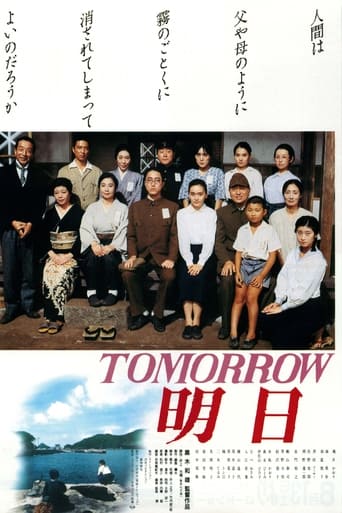
TOMORROW 明日 (1988)
On August 9, 1945, the Americans dropped an atomic bomb on Nagasaki. This film, based on a story by Mitsukaru Inoue, describes the daily life of people in Nagasaki the day before that fateful event. It presents the human drama of people's lives, and their feelings of joy and sadness. These include a newlywed couple, an expectant mother, and lovers who must say farewell because the boy is called to serve in the army. Each of these people, like others in the city, hoped to live with their dreams for ‘tomorrow’. But tomorrow never comes for them, as their lives are brought to an abrupt and unexpected end. Knowing how the story ends, in this case, doesn't detract from it at all; rather, it enhances the emotional impact, which is further heightened by the poignant musical score from Teizo Matsumura. 'Ashita' is the first film in Kazuo Kuroki's 'War Requiem Trilogy,' which also includes 'Utsukushii Natsu Kirishima' (2002) and 'Chichi to Kuraseba' (2004).
Distribuție
- 桃井かおり — Tsuruko Miura
- 南果歩 — Yae Miura
- 仙道敦子 — Akiko Miura
- 黒田アーサー — Tsuneo Ishihara
- 長門裕之 — Taiichiro Miura
- 佐野史郎 — Shoji Nakagawa
- 田中邦衛 — Shoji's stepfather
- 絵沢萠子 — Shoji's mother
- 原田芳雄 — Yamaguchi
- 馬渕晴子 — Tsui Miura
- Shinichiro Okano — Hiro
- なべおさみ — Mizumoto
Curiozități
Tomorrow , also known as Ashita and Tomorrow – ashita, is a 1988 Japanese drama film co-written and directed by Kazuo Kuroki. It is the first film in Kuroki’s "War Requiem" thematic trilogy, followed by A Boy’s Summer in 1945 (2002) and The Face of Jizo (2004).
Citește pe Wikipedia · Text din Wikipedia, CC BY-SA 4.0. Date din Wikidata.
Recomandate
- My Neighbor Adolf 2022 · ★ 6.6
- Cuibul 2020 · ★ 6.1
- Lorelei 2020 · ★ 6.0
- The Padre 2018 · ★ 5.9
- The Young One 1960 · ★ 7.0
- The Ballad of Narayama 1983 · ★ 7.5
- Tokyo Family 2013 · ★ 7.3
- Bastard Out of Carolina 1996 · ★ 7.1
- The Kindness of Strangers 2019 · ★ 6.4
- In Full Bloom 2019 · ★ 6.8
- Călătorie către regăsire 2019 · ★ 6.1
- Fist of the North Star: The Legend of Kenshiro 2008 · ★ 6.7