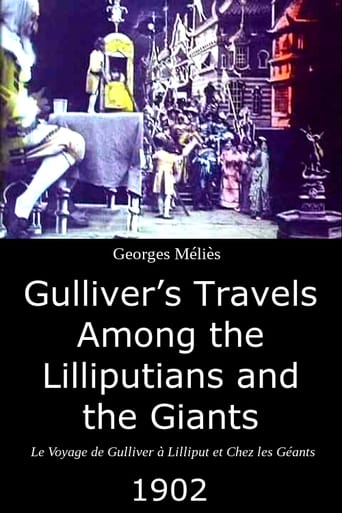
Gulliver's Travels Among the Lilliputians and the Giants (1902)
Le Voyage de Gulliver à Lilliput et chez les géants
Georges Méliès' adaptation of Jonathan Swift's "Gulliver's Travels" is most distinguished, today, for being a color film of the classic story. Color was rare in 1902 (and many years after) as non-tinted color has to be hand painted on the film; this was an arduous task. Also notable is the film's short running time of approximately five minutes. Much of the original work is not covered, but viewers were expected to be familiar with the story, and enjoy the filmed highlights. There are a couple of scenes missing; according to contemporary reports, Gulliver's shipwreck was certainly included. You can do a lot in a few minutes, as Mr. Méliès includes a re-make of his own "Une partie de cartes" (1896), which already looked like something previously covered by the Lumière Brothers.
- Date of release
- 1902-11-22
- TMDB
- 6.1 / 10 (48)
- Runtime
- 4m
- Genres
- Fantasy
- Director
- Georges Méliès
Casting
- Georges Méliès — Gulliver
Interesting facts
- Based on: Gulliver's Travels
Le Voyage de Gulliver à Lilliput et chez les Géants, released in the United States as Gulliver's Travels Among the Lilliputians and the Giants and in the United Kingdom as Gulliver's Travels—In the land of the Lilliputians and the Giants, is a 1902 French silent trick film directed by Georges Méliès, based on Jonathan Swift's 1726 novel Gulliver's Travels.
Production
Méliès himself plays Gulliver in the film. The visual differences of scale between Gulliver and the countries he visits were created using multiple exposures and miniature models; Méliès uses substitution splices and careful exposure design to merge the various elements and give them a sense of apparently seamless action.
Read on Wikipedia · Text from Wikipedia, CC BY-SA 4.0. Data from Wikidata.
Recommended
- Le manoir du diable 1896 · ★ 6.4
- One Hundred and One Nights 1995 · ★ 6.1
- Destino 2003 · ★ 7.2
- The Hilarious Posters 1906 · ★ 6.2
- Pirates of the Caribbean: Tales of the Code: Wedlocked 2011 · ★ 6.7
- Under the Sea: A Descendants Story 2018 · ★ 7.1
- The Bewitched Inn 1897 · ★ 6.3
- The Little Matchgirl 2006 · ★ 7.4
- Sketch 2025 · ★ 7.0
- Thru the Mirror 1936 · ★ 7.2
- Chips Ahoy 1956 · ★ 6.6
- The Little Match Girl 1928 · ★ 6.9