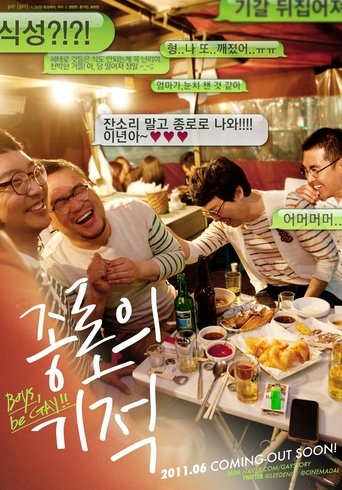
Miracle on Jongno Street (2011)
종로의 기적
Boys, Be Gay!!
A story about 4 gay men who try to lead a normal life in Korea, the conservative and harsh country for LGBT in Asia. In the middle of making a queer film Jun-moon, a director, loses his self-confidence due to social scrutiny regarding his sexual orientation. Byung-gwon, a gay rights activist, has been participating in movements to establish equal rights for homosexual laborers. Young-soo, a chef who moved from the countryside 15 years ago, lived a lonely life but he finds happiness after joining a gay choir. Yol, who works for a major company, dreams of the day him and his partner, can have a legal wedding with overcoming the prejudice against people living with HIV/AIDS.
- Date of release
- 2011-06-02
- TMDB
- 6.0 / 10 (1)
- Runtime
- 1h 59m
- Genres
- Documentary
- Director
- Lee Hyuk-sang
Casting
- So Joon-moon — Himself
- Jeong Yol — Himself
- Choi Young-su — Himself
- Jang Byeong-kwon — Himself
Interesting facts
Miracle on Jongno Street is a 2010 South Korean documentary film directed by Lee Hyuk-sang. The film follows four gay men connected to Jongno, Seoul, and depicts their everyday lives, relationships, activism, and experiences of coming out. It premiered at the 15th Busan International Film Festival in October 2010, where it received the BIFF Mecenat Award, and was released theatrically in South Korea on June 2, 2011.
Production
The film was directed by Lee Hyuk-sang and produced by Kim Il-ran. It was produced by PINKS, a queer feminist media collective, in collaboration with Chingusai, a Korean gay men's human rights organization. According to an interview in Cine21, the film developed from a coming-out project begun by Chingusai in 2003, and Lee became involved while working with PINKS on films related to sexual minority communities.
In a director's note published by PINKS, Lee described the documentary as a record of four gay men living openly amid discrimination against sexual minorities in South Korea. The film was shot in color on HDV. Cinematography was credited to Lee Hyuk-sang, Kim Il-ran, Kim Seong-hui, and Hong Ji-yu; editing was credited to Lee Hyuk-sang and Kim Il-ran; and music was composed by Jeong Ji-yun.
Read on Wikipedia · Text from Wikipedia, CC BY-SA 4.0. Data from Wikidata.
Recommended
- Scotty and the Secret History of Hollywood 2018 · ★ 6.0
- The Last Repair Shop 2024 · ★ 7.5
- Heart of a Dog 2015 · ★ 6.5
- BLACKPINK: Light Up the Sky 2020 · ★ 8.2
- A Secret Love 2020 · ★ 7.4
- Salinger 2013 · ★ 6.4
- David Byrne's American Utopia 2020 · ★ 7.5
- Robin's Wish 2020 · ★ 7.0
- Whitney 2018 · ★ 7.3
- Marvel Studios Assembled: The Making of Hawkeye 2022 · ★ 7.2
- Cameraperson 2016 · ★ 6.7
- Being James Bond 2021 · ★ 7.8