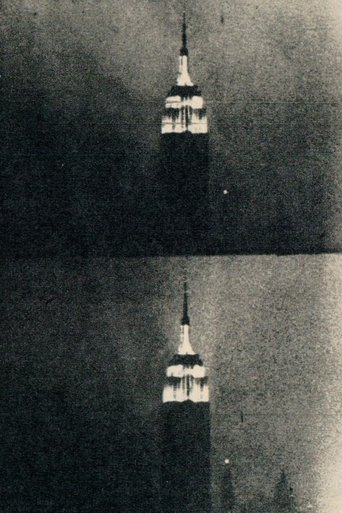
Empire (1965)
Filmed by Jonas Mekas from the 44th floor of the Time-Life Building, “Empire” explores the passage of time without the use of characters or a traditional narrative. The film, that consists of one stationary shot of the Empire State Building, was made from standard 1,200-foot rolls of 16mm film with a more than eight-hour runtime.
- Date of release
- 1965-03-06
- TMDB
- 4.4 / 10 (46)
- Runtime
- 7h 59m
- Genres
- Documentary
- Director
- Andy Warhol
Casting
- Jonas Mekas — Self (uncredited)
- Andy Warhol — Self (uncredited)
Interesting facts
- Filmed in: New York City
Empire is a 1965 American silent art film by Andy Warhol. When projected according to Warhol's specifications, it consists of eight hours and five minutes of slow motion black-and-white footage of an unchanging view of New York City's Empire State Building. The silent film does not have conventional narrative or characters, and largely reduces the experience of cinema to the passing of time. Warhol stated that the purpose of the film was "to see time go by."
Production
The initial idea for Empire came from John Palmer, a young filmmaker affiliated with Jonas Mekas. Palmer had been sleeping occasionally on the roof of Mekas's Film Maker's Cooperative, which had an impressive view of the tower, only a few blocks away. He told Mekas that he thought an image of the floodlit building would make a good Warhol film, and Mekas passed the idea to Warhol.
In April 1964, the upper 30 floors of the Empire State Building were floodlighted for the first time in connection with the opening of the New York World's Fair in Queens. As the only floodlit skyscraper in New York City, the impact of the lighting was dramatic, with one person calling the tower's illuminated crown "a chandelier suspended in the sky".
For a shooting venue, Warhol made arrangements to use an office belonging to the Rockefeller Foundation on the 41st floor of the Time-Life Building at 51st Street and 6th Avenue. Cinematography took place overnight on July 24 and 25, 1964. Present for filming were Mekas, Warhol, Palmer, Gerard Malanga, Marie Desert (Mekas' girlfriend), and Henry Romney (of the Rockefeller Foundation).
In contrast to Warhol's earlier films, which had been shot with a Bolex camera limited to three minutes of shooting time, Empire was filmed on an Auricon camera that allowed for takes of around 33 minutes. In the Rockefeller Foundation office, Mekas framed the shot for Warhol's approval, and filming commenced at 8:06 pm, about ten minutes before sunset.
Empire was shot on ASA 400 Tri-X stock, which was developed as a negative rather than a reversal, and push-processed to ASA 1000 to compensate for the dark conditions of filming. The push-processing gives the film a graininess that calls attention to the medium of the film stock itself during projection in a manner that Douglas Crimp compared to the way that ink in Warhol's silkscreen paintings is present as both blobs of ink and as part of the i…
Read on Wikipedia · Text from Wikipedia, CC BY-SA 4.0. Data from Wikidata.
Recommended
- As I Was Moving Ahead Occasionally I Saw Brief Glimpses of Beauty 2000 · ★ 7.8
- Dangerous Days: Making Blade Runner 2007 · ★ 7.8
- The Curious Birth of Benjamin Button 2009 · ★ 7.0
- Ex Libris: The New York Public Library 2017 · ★ 6.4
- You Can See Everything 2026 · ★ 9.1
- Crystal Lake Memories: The Complete History of Friday the 13th 2013 · ★ 7.9
- National Gallery 2014 · ★ 7.3
- Live Aid 1985 · ★ 7.8
- Zeitgeist: Moving Forward 2011 · ★ 7.0
- Woody Allen: A Documentary 2011 · ★ 6.9
- Never Sleep Again: The Elm Street Legacy 2010 · ★ 7.8
- Woodstock 1970 · ★ 7.6