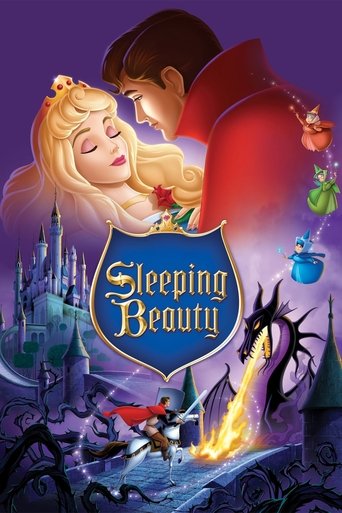
Sleeping Beauty (1959)
Awaken to a World of Wonders!
Cursed to die by the evil fairy Maleficent when she was a baby, Princess Aurora is sent into hiding under protection from three good fairies. As she grows up far away, Maleficent becomes increasingly determined to seal the princess's fate.
- Date of release
- 1959-02-17
- TMDB
- 6.9 / 10 (5658)
- Runtime
- 1h 15m
- Genres
- Fantasy, Animation, Romance, Family
- Director
- Clyde Geronimi
Casting
- Mary Costa — Princess Aurora (voice)
- Bill Shirley — Prince Phillip (voice)
- Eleanor Audley — Maleficent (voice)
- Verna Felton — Flora / Queen Leah (voice)
- Barbara Luddy — Merryweather (voice)
- Barbara Jo Allen — Fauna (voice)
- Taylor Holmes — King Stefan (voice)
- Bill Thompson — King Hubert (voice)
- Marvin Miller — Narrator (voice) (uncredited)
- Candy Candido — Maleficent’s Goon (voice) (uncredited)
- Pinto Colvig — Maleficent’s Goon (voice) (uncredited)
- Bob Amsberry — Maleficent’s Goon (voice) (uncredited)
Interesting facts
- Box office: $51.6M
- Budget: $6M
- Earned 8.6× its budget
- Based on: The Beauty Sleeping in the Wood and The Sleeping Beauty
- Awards: 0 · Nominations: 1
Sleeping Beauty is a 1959 American animated musical fantasy film produced by Walt Disney Productions and released by Buena Vista Film Distribution. Based on Charles Perrault's 1697 fairy tale, the film follows Princess Aurora, who was cursed by the evil fairy Maleficent to die from pricking her finger on the spindle of a spinning wheel on her 16th birthday; she is rescued by three good fairies, who change the curse so that Aurora falls into a deep sleep and will be awakened by true love's kiss. The production was supervised by Clyde Geronimi, and was directed by Wolfgang Reitherman, Eric Larson, and Les Clark.
Production
Walt Disney first considered making an animated version of Charles Perrault's 1697 fairy tale "Sleeping Beauty" in 1938; Joe Grant did preliminary story work in the late 1930s, but the project did not materialize at the time. After a preview audience's positive response to Cinderella, Disney registered Sleeping Beauty as a planned production title with the Motion Picture Association of America on January 19, 1950.
Key story work was done by Ted Sears, Winston Hibler, Bill Peet, and Ralph Wright, who were joined by other story artists as production continued. They discarded the second half of Perrault's original tale, which tells about the life of sleeping beauty married to an unknown prince, and focused on its first half to develop a more compelling romance between the characters.
By June 1952, the full storyboard of Sleeping Beauty was completed, but Disney rejected it, finding its approach too similar to his studio's earlier fairy tale features. The story artists discarded the original version and started from scratch, but kept several ideas from earlier suggestions, such as the prince's encounter with the princess before the curse is fulfilled, and a shorter deep sleep.
Disney wanted a more serious narrative direction for Sleeping Beauty, which resulted in several gags and sequences being cut; in one, the Three Good Fairies (who had been renamed Flora, Fauna, and Merryweather) try to bake a birthday cake for Aurora and accidentally blow up the oven.
Walt Disney spent three years searching for a voice for Princess Aurora and considered shelving the project entirely before Mary Costa was cast by June 1952. She was invited to audition by the film's original composer Walter Schumann, who heard her singing at a dinner party for the entertainment industry.
Read on Wikipedia · Text from Wikipedia, CC BY-SA 4.0. Data from Wikidata.
Recommended
- Cinderella 1950 · ★ 7.1
- Maleficent 2014 · ★ 7.1
- Barbie Fairytopia: Magic of the Rainbow 2007 · ★ 6.9
- Cinderella and the Secret Prince 2018 · ★ 6.5
- Snow White and the Seven Dwarfs 1938 · ★ 7.1
- Barbie Mariposa & the Fairy Princess 2013 · ★ 6.9
- The Little Mermaid 1989 · ★ 7.4
- Barbie: A Fairy Secret 2011 · ★ 6.9
- The Thief and the Cobbler 1993 · ★ 7.2
- Cinderella III: A Twist in Time 2007 · ★ 6.6
- Barbie Fairytopia: Mermaidia 2006 · ★ 6.9
- Belle's Magical World 1998 · ★ 6.2