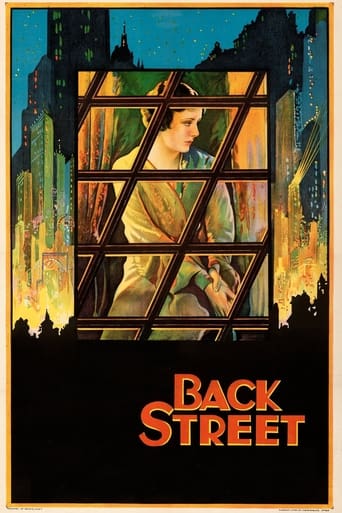
Back Street (1932)
A story that will grip you with its powerful emotional appeal written by one of America's foremost novelists... A picture with an amazing cast of star players
A woman's love for and devotion to a married man results in her being relegated to the "back streets" of his life.
- Date of release
- 1932-08-04
- TMDB
- 6.4 / 10 (14)
- Runtime
- 1h 33m
- Genres
- Drama, Romance
- Director
- John M. Stahl
Casting
- Irene Dunne — Ray Schmidt
- John Boles — Walter D. Saxel
- George Meeker — Kurt Shendler
- Zasu Pitts — Mrs. Dole
- June Clyde — Freda Schmidt
- William Bakewell — Richard Saxel
- Arletta Duncan — Beth Saxel
- Doris Lloyd — Corinne Saxel
- Paul Weigel — Adolph Schmidt
- Jane Darwell — Mrs. Adolph Schmidt
- Shirley Grey — Francine
- James Donlan — Profhero
Interesting facts
- Based on: Back Street
Back Street is a 1932 American pre-Code drama film directed by John M. Stahl and starring Irene Dunne and John Boles. Based on the best-selling novel of the same title by Fannie Hurst, it tells the story of a woman who spends her life as the secret mistress of a wealthy married man. The devotion and love of the woman to the married man determines that she will be the “back streets” of him in the whole life; a story of a love that was not destined. This was the first of three film versions of Hurst's novel; remakes were released in 1941 and 1961.
Production
Back Street tells the story of Ray Schmidt in a direct fashion, reflecting the very simple perspective of a woman of her kind in the 1930s. The screenplay writers, Gladys Lehman and Fannie Hurst, wrote the story in straightforward chronological order. Director John M. Stahl had a clear, easily comprehensible directing style, making sure that scenes lasted a long time and including mainly far-shots and relatively few close-up scenes.
The scenes are connected with straight fluency, having strong causal connections between each other. The cinematographer, Karl Freund, incorporated pictorial techniques, such as employment of a moving camera on set or changes in lighting, to make the message of the scene more apparent. Freund pioneered the “Unchained Camera”, which was revolutionary in its time. A new variety and range of shots were offered with this style of shooting.
The performances of the actors were restrained. The portrayals of Ray by Irene Dunne and Walter by John Boles are simple and untheatrical, offering a real-life feel. Unlike many films of this era, Back Street does not seem like a filmed stage play, but a slice-of-life that was relatable and revealing of the truth of many women's lives during the bleak period of the Great Depression.
Read on Wikipedia · Text from Wikipedia, CC BY-SA 4.0. Data from Wikidata.
Recommended
- City Girl 1930 · ★ 7.5
- Strangers When We Meet 1960 · ★ 6.4
- Possessed 1931 · ★ 6.9
- The Secret: Dare to Dream 2020 · ★ 7.4
- Flamingo Road 1949 · ★ 7.0
- Sunrise: A Song of Two Humans 1927 · ★ 7.8
- The Magic of Ordinary Days 2005 · ★ 7.5
- Nobody Has to Know 2022 · ★ 6.7
- Jane Eyre 1997 · ★ 7.1
- The Lost Husband 2020 · ★ 6.7
- Last Night 2010 · ★ 6.1
- Persuasion 1995 · ★ 7.2