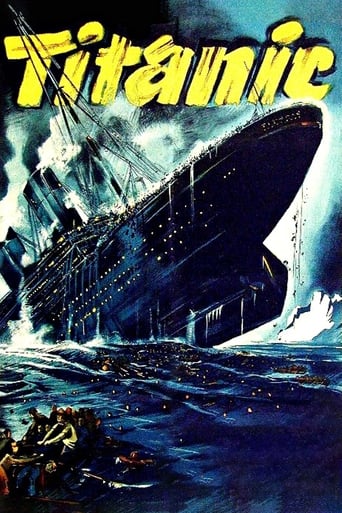
Titanic (1943)
In 1912, the Titanic embarks on its inevitable collision course with history. In the wake of the over-spending required to build the largest luxury ship in the world, White Star Line executive Sir Bruce Ismay schemes to reverse the direction of his company's plummeting stock value. Onboard the Titanic, brave German 1st Officer Petersen struggles to convince his self-important British superiors not to overexert the ship's engines.
- Date of release
- 1943-09-24
- TMDB
- 6.1 / 10 (95)
- Runtime
- 1h 28m
- Genres
- Drama, History
- Director
- Werner Klingler, Herbert Selpin
Casting
- Sybille Schmitz — Sigrid Olinsky
- Hans Nielsen — First Officer Petersen
- Kirsten Heiberg — Gloria
- Ernst Fritz Fürbringer — Sir Joseph Bruce Ismay
- Karl Schönböck — John Jacob Astor
- Charlotte Thiele — Madeleine Astor
- Otto Wernicke — Captain Edward John Smith
- Franz Schafheitlin — Hunderson
- Sepp Rist — Jan
- Claude Farell — Manicure Hedi (as Monika Burg)
- Jolly Bohnert — Marcia (uncredited)
- Fritz Böttger — Lord Douglas (uncredited)
Interesting facts
Titanic is a 1943 German propaganda film made during World War II in Berlin by Tobis Productions for UFA, depicting the catastrophic sinking of RMS Titanic in 1912. This was the third German language dramatization of the event, following a silent film released in 1912 just four months after the sinking and the British produced German film Atlantik released in 1929.
Production
The script was adapted from a popular German novel by Josef Pelz von Felinau, although he remained uncredited in the finished film. After the Propaganda Ministry gave final script approval in March 1942, shooting of interior scenes began shortly thereafter at Tobis Film's Johannisthal Studios in Berlin.
Titanic endured many production difficulties, including a clash of egos, massive creative differences and general war-time frustrations. As filming progressed, more extravagant sets were demanded by Selpin, as well as additional resources from the German Navy – these demands were all approved by Goebbels, despite the mounting costs and the drain on the wartime German economy.
After one week of troubled shooting on Cap Arcona, with Allies bombing raids occurring not far away, Herbert Selpin called a crisis meeting where he made unflattering comments about the Kriegsmarine officers who were supposed to be marine consultants for the film, but were more interested in molesting female cast members.
The film cost almost 4 million ℛ︁ℳ︁ (equivalent to roughly US$15 million in 2020 terms), although various sources have erroneously propagated an inflation-adjusted figure as high as $180 million. Regardless, it was the most expensive German production to that point.
Read on Wikipedia · Text from Wikipedia, CC BY-SA 4.0. Data from Wikidata.
Recommended
- A Night to Remember 1958 · ★ 7.7
- Voyage of the Damned 1976 · ★ 6.0
- Britannic 2000 · ★ 6.8
- The Sea Chase 1955 · ★ 6.3
- The Last Train 2006 · ★ 7.2
- The Enigma of Kaspar Hauser 1974 · ★ 7.3
- Origin 2023 · ★ 6.2
- The Cat's Meow 2002 · ★ 5.8
- Corsage 2022 · ★ 6.1
- Exodus 1960 · ★ 6.7
- The Longest Day 1962 · ★ 7.6
- The Aviator 2004 · ★ 7.2