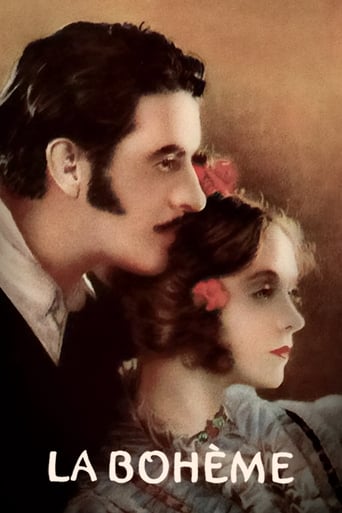
La Bohème (1926)
A group of starving artists try to survive in 1830s Paris, including a seamstress and the would-be playwright she loves.
- Date of release
- 1926-03-13
- TMDB
- 6.4 / 10 (16)
- Runtime
- 1h 33m
- Genres
- Romance, Drama
- Director
- King Vidor
Casting
- Lillian Gish — Mimi
- John Gilbert — Rodolphe
- Renée Adorée — Musette
- Roy D'Arcy — Vicomte Paul
- Edward Everett Horton — Benoit - Janitor
- Karl Dane — Benoit - Janitor
- Gino Corrado — Marcel
- George Hassell — Schaunard
- Mathilde Comont — Madame Benoit
- Eugene Pouyet — Bernard
- Frank Currier — Theatre Manager
- David Mir — Alexis
Interesting facts
- Based on: La bohème and Scenes of Bohemian Life
La Bohème is a 1926 American silent drama film directed by King Vidor, based on the 1896 opera La bohème by Giacomo Puccini. Lillian Gish and John Gilbert star in a tragic romance in which a tubercular seamstress sacrifices her life so that her lover, a bohemian playwright, might pen his masterpiece. Gish, at the height of her influence with Metro-Goldwyn-Mayer studios, asserted significant control over the production, determining the story, director, cast, cinematography, and costume design. In February 2020, the film was shown at the 70th Berlin International Film Festival, as part of a retrospective dedicated to King Vidor's career.
Production
Metro-Goldwyn-Mayer producer Irving Thalberg matched the two biggest stars on the studio roster for the adaption of La bohème: John Gilbert, fresh from his triumphant success in The Big Parade (1925), with one of the greatest actresses in Hollywood, Lillian Gish, a veteran of legendary film director D. W. Griffith’s stock company.
The highly sought after Gish, who extracted an $800,000 salary from Thalberg for two pictures, was M-G-M’s highest paid actor and could dictate her terms. As such, her contract "stipulated for her input into stories, directors, and cast, although the studio kept the final decision".
Gish, who possessed creative and practical expertise in all aspects of film-making, selected an adaption of Italian composer Giacomo Puccini's 1896 opera La bohème for her debut film with the studio. Viewing two-reels of the as yet unreleased The Big Parade and accompanied by producer Thalberg, she was impressed and approved her pairing with Gilbert and much of the film’s supporting cast, as well enlisting director King Vidor.
Vidor, a great admirer of D.W. Griffith, acquiesced when Gish insisted on full rehearsals in the "Master’s style" for each scene, but she abandoned the practice when cast and crew registered objections. Another Gish idea had genuine promise: she and Gilbert would refrain from any physical contact between their characters Mimi and lover Rodolphe so as to create a powerful sense of anticipation in the audience: only in the ultimate scene would they…
Gish benefited from the distinctive soft-focus lighting technique developed expressly for her by Orphans of the Storm cinematographer Hendrik Sartov, and termed the "Lillian Gish". (M-G-M's Mae Murray, a top ranking star, employed the talented cinematographer Oliver Marsh to handle her closeups with use of the "baby spot" lighting that erased signs of aging.) Gilbert's appearance was not enhanced by these "glamorized, heavily gauzed" effects and…
Read on Wikipedia · Text from Wikipedia, CC BY-SA 4.0. Data from Wikidata.
Recommended
- The Secret: Dare to Dream 2020 · ★ 7.4
- The Lost Husband 2020 · ★ 6.7
- Nobody Has to Know 2022 · ★ 6.7
- Lovely, Still 2009 · ★ 6.6
- The Sleeping Dictionary 2003 · ★ 6.6
- The Magic of Ordinary Days 2005 · ★ 7.5
- Peter Ibbetson 1935 · ★ 7.0
- All My Life 2020 · ★ 7.7
- I Can't Think Straight 2008 · ★ 7.5
- Where the Red Fern Grows 1974 · ★ 6.9
- Departure 2016 · ★ 6.3
- Strangers When We Meet 1960 · ★ 6.4