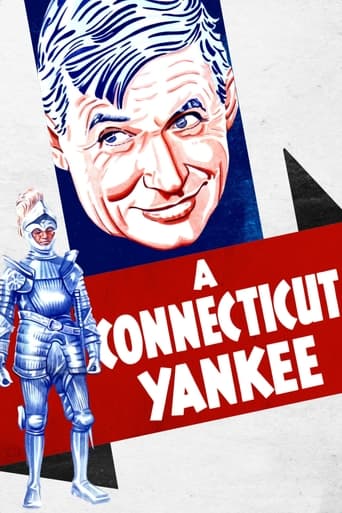
A Connecticut Yankee (1931)
More Laughs than the law allows!
Making a delivery to a mysterious mansion in a rainstorm, radio salesman Hank Martin is knocked out when a suit of armor topples on him. Upon awakening, Hank finds himself in the time of King Arthur. At Camelot Castle, Hank uses a cigarette lighter and his skill with a lasso to save himself from being executed as a demon. Hank so impresses Arthur that the king orders him to joust with one of his knights to save the life of Princess Alisande.
- Date of release
- 1931-04-06
- TMDB
- 6.1 / 10 (8)
- Runtime
- 1h 35m
- Genres
- Comedy, Fantasy, Romance
- Director
- David Butler
Casting
- Will Rogers — Hank Martin
- William Farnum — King Arthur / Inventor
- Frank Albertson — Emile le Poulet / Clarence
- Maureen O'Sullivan — Alisande / Woman in Mansion
- Brandon Hurst — Merlin / Doctor in Mansion
- Myrna Loy — Queen Morgan le Fay / Evil Sister in Mansion
- Mitchell Harris — Sagramor / Butler in Mansion
- Stanley Blystone — King's Knight (uncredited)
- Heinie Conklin — Sneezing Man at Radio Station (uncredited)
- Louise Emmons — Old Hag in Dungeon (uncredited)
Interesting facts
- Based on: A Connecticut Yankee in King Arthur's Court
A Connecticut Yankee is a 1931 American pre-Code fantasy comedy film adaptation of Mark Twain's 1889 novel, A Connecticut Yankee in King Arthur's Court. It was directed by David Butler to a script by William M. Conselman, Owen Davis, and Jack Moffitt. It was produced by Fox Film Corporation, who had earlier produced the 1921 silent adaptation of the novel, A Connecticut Yankee in King Arthur's Court. A Connecticut Yankee is the first sound film adaptation of Twain's novel. It is unrelated to the 1927 musical also titled A Connecticut Yankee.
Production
Fox was likely inspired to produce A Connecticut Yankee based on the success of the 1921 silent film. The 1931 version was likewise successful, and was re-released in 1936. The film cost $750,000 to make; the production used 174 Austin automobiles, among other pieces of modern machinery, to make the final battle scene. It was a commercial success despite being released during the Depression.
Although the film was released in black and white, director David Butler used progressively darker shades of pink tint to emphasize a scene in which Morgana Le Fay flirts with Hank Martin.
Read on Wikipedia · Text from Wikipedia, CC BY-SA 4.0. Data from Wikidata.
Recommended
- Monty Python and the Holy Grail 1975 · ★ 7.8
- A Midsummer Night's Dream 1999 · ★ 6.4
- Topper Returns 1941 · ★ 6.5
- Bell, Book and Candle 1958 · ★ 6.6
- Charlotte's Web 2006 · ★ 6.2
- The Princess Bride 1987 · ★ 7.7
- Dolittle 2020 · ★ 6.6
- Harold and the Purple Crayon 2024 · ★ 6.6
- Slumberland 2022 · ★ 7.2
- What's Love Got to Do with It? 2023 · ★ 6.1
- The Adventures of Baron Munchausen 1988 · ★ 7.0
- Godmothered 2020 · ★ 6.7