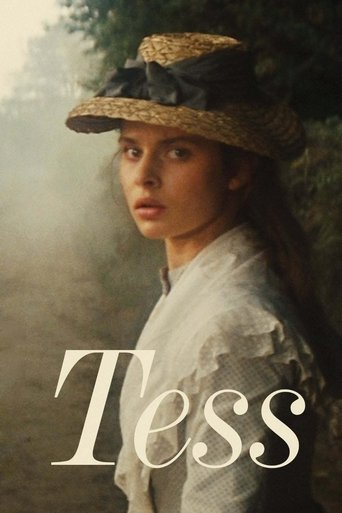
Tess (1979)
She was born into a world where they called it seduction, not rape. What she did would shatter that world forever.
A strong-willed peasant girl is sent by her father to the estate of some local aristocrats to capitalize on a rumour that their families are from the same line. This fateful visit commences an epic narrative of sex, class, betrayal, and revenge.
- Date of release
- 1979-10-06
- TMDB
- 7.1 / 10 (403)
- Runtime
- 2h 52m
- Genres
- Drama, Romance
- Director
- Roman Polanski
Casting
- Nastassja Kinski — Tess Durbeyfield
- Peter Firth — Angel Clare
- Leigh Lawson — Alec d'Urberville
- John Collin — John Durbeyfield
- Rosemary Martin — Mrs. Durbeyfield
- Carolyn Pickles — Marian
- Richard Pearson — Vicar of Marlott
- David Markham — Reverend Mr. Clare
- Pascale de Boysson — Mrs. Clare
- Suzanna Hamilton — Izz Huett
- Caroline Embling — Retty
- Tony Church — Parson Tringham
Interesting facts
- Based on: Tess of the d'Urbervilles
- Filmed in: Locronan, Morlaix, and Plomelin
- Awards: 5 · Nominations: 7. Including: Academy Award for Best Cinematography; Academy Award for Best Costume Design; Academy Award for Best Production Design; National Board of Review: Top Ten Films
Tess is a 1979 epic romantic drama film directed by Roman Polanski, and starring Nastassja Kinski, Peter Firth, and Leigh Lawson. Adapted from Thomas Hardy's 1891 novel Tess of the d'Urbervilles, the screenplay was written by Gérard Brach, John Brownjohn, and Polanski.
Production
Polanski was inspired to make the film by his wife Sharon Tate, who gave him a copy of Tess of the d'Urbervilles. She said it would make a great film and expressed interest in playing the part of Tess. It was the last time Polanski saw her alive, as she was departing back for America while he stayed on a while longer in Europe to finish working on a film. She was murdered by the Manson Family on 9 August 1969 while he was away.
Polanski wrote the screenplay in French with his usual collaborator Gérard Brach, then it was translated and expanded by John Brownjohn. The story line largely follows that of the book, although the role of Alec d'Urberville is toned down.
Set in Dorset, England, the film was shot at various locations in France: Normandy (Cotentin, la Hague, Omonville-la-Rogue, Éculleville, Sainte-Croix-Hague, le Vast, Bricquebec, Saint-Jacques-de-Néhou, Hermanville-sur-Mer), Brittany (Locronan, le Leslay, Plomelin), and Nord-Pas-de-Calais (Condette). Scenes were also shot at the château de Brocéliande in Paimpont.
During the third month of shooting, on 28 October 1978, the cinematographer Geoffrey Unsworth died of a heart attack. Most of the scenes he had shot were exteriors that occur in the first half of the film. Ghislain Cloquet shot the remainder of the film, including most of the interior scenes. Both Unsworth and Cloquet were nominated and won an Academy Award for Best Cinematography.
The original musical score was composed by Philippe Sarde and orchestrated by Peter Knight. It was performed by the London Symphony Orchestra. The melody played by the character Angel Clare on a recorder is a popular Polish folk song "Laura i Filon".
Read on Wikipedia · Text from Wikipedia, CC BY-SA 4.0. Data from Wikidata.
Recommended
- Pride & Prejudice 2005 · ★ 8.0
- Far from the Madding Crowd 2015 · ★ 7.0
- Mansfield Park 1999 · ★ 6.7
- Wuthering Heights 1992 · ★ 6.7
- Tristan & Isolde 2006 · ★ 6.7
- Drums Along the Mohawk 1939 · ★ 6.5
- The Bridges of Madison County 1995 · ★ 7.7
- Out of Africa 1985 · ★ 7.2
- I Capture the Castle 2003 · ★ 6.7
- Safe Haven 2013 · ★ 7.2
- The Choice 2016 · ★ 7.2
- Dragonwyck 1946 · ★ 6.6