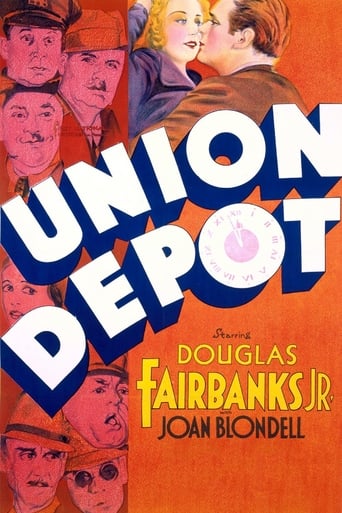
Union Depot (1932)
A Lifetime Crowded Into a Few Mad Hours! A Picture Shockingly Real—Lifting You Out of the Humdrum Routine, Pluning You Wildly Into Life's Melodrama!
Among the travelers of varied backgrounds that meet and interact on one night at Union Depot, a metropolitan train station, are Chick and his friend Scrap Iron, both newly released from prison after serving time for vagrancy. Hungry and desperate for a break, Chick fortuitously comes across across a valise abandoned by a drunken traveler. In it he finds a shaving kit and a suit of clothes with a bankroll, which help transform the affable tramp into a dashing gent. After buying himself a meal, Chick seeks some female companionship among the many hustlers who walk the station. He propositions Ruth Collins, a stranded, out-of-work showgirl and takes her to the station's hotel.
- Date of release
- 1932-01-14
- TMDB
- 6.1 / 10 (18)
- Runtime
- 1h 7m
- Genres
- Comedy, Drama, Romance
- Director
- Alfred E. Green
Casting
- Douglas Fairbanks Jr. — Charles 'Chick' Miller
- Joan Blondell — Ruth Collins
- Guy Kibbee — Scrap Iron Scratch
- Alan Hale — The Baron, aka Bushy Sloan
- David Landau — Kendall
- George Rosener — Dr. Bernardi
- Earle Foxe — Jim Parker
- Frank McHugh — The Drunk
- Adrienne Dore — Sadie
- Irving Bacon — Depot Hotel Waiter (uncredited)
- George Chandler — Panhandler Wanting One Dollar (uncredited)
- Mary Doran — Daisy (uncredited)
Interesting facts
- Box office: $637K
- Budget: $284K
- Earned 2.2× its budget
Union Depot is a 1932 American pre-Code melodrama film directed by Alfred E. Green for Warner Bros., starring Douglas Fairbanks Jr. and Joan Blondell, and based on an unpublished play by Joe Laurie Jr., Gene Fowler, and Douglas Durkin. The film, an ensemble piece for the studio's contract players, also features performances by Guy Kibbee, Alan Hale, Frank McHugh, David Landau, and George Rosener. In the United Kingdom it was released under the title Gentleman for a Day. The film's copyright was registered in 1932 and renewed in 1959. It will enter the American public domain on January 1, 2028.
Production
Production on Union Depot began in mid-October 1931.
The high cost of constructing the large, elaborate train-station set for Union Depot proved in the long run to be worthwhile for Warner Bros., which had purchased First National Pictures several years prior to the production of Union Depot. An article on the Turner Classic Movies site notes "...the film did leave one legacy at the studio.
Because Union Depot was produced prior to the rigid enforcement of the Motion Picture Production Code, the film's storyline contains many topics that would have, by the latter half of 1934, jeopardized the certificate of approval needed for a production's release in the United States. Some of these forbidden topics in Union Depot include the following:
Ruth reads what is implied to be very lewd or "off-color" stories to Dr. Bernardi.
Though Chic stops short of taking advantage of Ruth's plight, she makes it clear that she has "been around" and is willing to do whatever is necessary for the price of a train ticket. Despite this, she emerges unscathed, which ran counter to one of the Hays Code's requirements that "sympathy of the audience should never be thrown to the side of the crime, wrongdoing, evil or sin".
Read on Wikipedia · Text from Wikipedia, CC BY-SA 4.0. Data from Wikidata.
Recommended
- You Will Meet a Tall Dark Stranger 2010 · ★ 5.9
- Hitch 2005 · ★ 6.6
- What's Love Got to Do with It? 2023 · ★ 6.1
- Irreplaceable You 2018 · ★ 7.0
- Love Sarah 2020 · ★ 6.2
- The Other Sister 1999 · ★ 6.4
- L.A. Without a Map 1999 · ★ 5.8
- Jersey Girl 2004 · ★ 6.2
- Christmas with You 2022 · ★ 5.9
- Prom Pact 2023 · ★ 7.2
- Let's Make Love 1960 · ★ 6.4
- Platinum Blonde 1931 · ★ 6.6