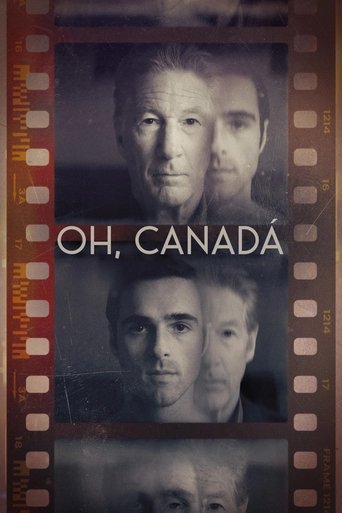
Oh, Canada (2024)
Famed Canadian-American leftist documentary filmmaker Leonard Fife was one of sixty thousand draft evaders and deserters who fled to Canada to avoid serving in Vietnam. Now in his late seventies, Fife is dying of cancer in Montreal and has agreed to a final interview in which he is determined to bare all his secrets at last, to demythologize his mythologized life.
- Data de estreia
- 2024-12-06
- TMDB
- 5.7 / 10 (107)
- Duração
- 1 h 34 min
- Géneros
- Drama
- Realizador
- Paul Schrader
Elenco
- Richard Gere — Leo Fife
- Uma Thurman — Emma / Gloria
- Jacob Elordi — Young Leo Fife
- Michael Imperioli — Malcolm
- Victoria Hill — Diana
- Caroline Dhavernas — Rene
- Penelope Mitchell — Sloan Ambrose / Amy
- Kristine Froseth — Alicia Fife
- Megan Mackenzie — Amanda
- Peter Hans Benson — Benjamin Chapman
- Scott Jaeck — Jackson Chapman
- Cornelia Guest — Jessie Chapman
Curiosidades
Oh, Canada is a 2024 American drama film written and directed by Paul Schrader, based on the 2021 novel Foregone by Russell Banks. It stars Richard Gere, Uma Thurman, Michael Imperioli, Jacob Elordi, Victoria Hill, Penelope Mitchell and Kristine Froseth. The film marked the second collaboration between Gere and Schrader after American Gigolo (1980) as well as Schrader's second adaptation of a novel by Banks after 1997's Affliction.
Production
Schrader decided to make a movie about mortality after contracting long COVID and being hospitalized three times. He settled on adapting his longtime friend Russell Banks' novel Foregone after Banks fell ill with cancer. He had previously adapted Banks' novel Affliction for the 1997 film of the same name. Banks asked Schrader to title the film Oh, Canada, his original name for the novel.
In addition to Banks' novel, Schrader said that he was influenced by Leo Tolstoy's The Death of Ivan Ilyich (also an influence on Foregone), and agreed with an interviewer that the film bore a resemblance to Andrei Tarkovsky's Mirror.
Schrader modified the character of Leo to be more unsympathetic, as he did not think that Leo's portrayal in the book was especially bad and wanted to "make [the story] a bit more biblical". With Banks' approval, he "ratcheted up the blackness" by "add[ing] a moment where [Leo] turns his back on his own son"; he likened the exchange to his own falling-out with his brother.
Schrader explained that he lived through the tumult of the 1960s and that several friends and family members attempted to dodge the draft, like Leo does in the film. He himself had received a draft deferment for health reasons. He stressed that the production design did not rely on '60s tropes, like long hair and bell-bottoms, and that in his memory, "a lot of people look pretty normal."
The film was produced on a low budget and with a compressed shooting schedule. Schrader explained that because of the low budget, "you're not going to make [your investors] rich, but you can make them whole", and that his investors are motivated not by investment returns but by the opportunity to enjoy the glamor of the film industry without excessive financial risk.
Ler na Wikipédia · Texto da Wikipédia, CC BY-SA 4.0. Dados do Wikidata.
Recomendados
- Pai Mãe Irmã Irmão 2025 · ★ 6.4
- Dad 1989 · ★ 6.4
- Blue Heron 2026 · ★ 6.5
- O Meu Nome é Alice 2014 · ★ 7.5
- Uma Outra Mulher 1988 · ★ 6.8
- Terapia Intensiva 2013 · ★ 6.1
- Tetro 2009 · ★ 6.8
- A Música Nunca Parou 2011 · ★ 7.2
- Pais e Filhas 2015 · ★ 7.2
- Regras da Casa 1999 · ★ 7.1
- The Railway Man - Uma Longa Viagem 2013 · ★ 6.8
- Trumbo 2015 · ★ 7.2