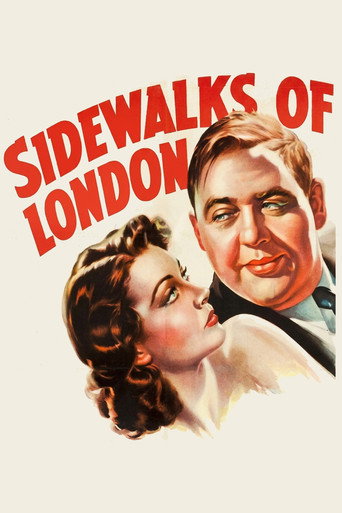
Nos Bastidores de Londres (1939)
St. Martin's Lane
Nas calçadas do distrito teatral de Londres, os artistas de rua ganham moedas suficientes para um quarto barato. Charles, que recita monólogos dramáticos, percebe que uma jovem batedora de carteiras, Libby, também tem talento para a dança e a inclui em seu número. Harley, o frequentador do teatro que nunca soube que Libby havia roubado sua carteira de cigarros de ouro, fica impressionado com a dança de Libby e a convida para levar Charles e os outros artistas de rua de seu grupo a uma festa após a peça. Libby vai sozinha. Assim, uma carreira teatral começa.
- Data de estreia
- 1939-09-06
- TMDB
- 7.4 / 10 (28)
- Duração
- 1 h 25 min
- Géneros
- Comédia, Drama
- Realizador
- Tim Whelan
Elenco
- Charles Laughton — Charles Staggers
- Vivien Leigh — Liberty
- Rex Harrison — Harley Prentiss
- Larry Adler — Constantine Dan
- Tyrone Guthrie — Gentry
- Maire O'Neill — Mrs. Such
- Gus McNaughton — Arthur Smith
- Polly Ward — Frankie
- Basil Gill — Magistrate
- Helen Haye — Selina
- David Burns — Hackett
- Phyllis Stanley — Della
Curiosidades
St Martin's Lane, also known as Sidewalks of London, London After Dark, and Partners of the Night, is a 1938 British black-and-white comedy drama starring Charles Laughton as a busker who teams up with a talented pickpocket, played by Vivien Leigh. The film co-stars Rex Harrison and Tyrone Guthrie in a rare acting appearance. It also features Ronald Shiner as the barman (uncredited). It was produced by Laughton's Mayflower Pictures Corporation.
Production
According to Vivien Leigh's biographer Alexander Walker, Laughton and Vivien Leigh did not get along while working together. Walker wrote that when an attempt was made to obtain Leigh's services for a film version of Cyrano de Bergerac, Laughton stated that she would have to dye her hair blonde. Leigh asked for a blonde wig, but Laughton insisted she dye her hair. The discussions fell through and Leigh felt slighted.
When Leigh was approached to make Sidewalks of London, she did not want to work with Laughton and she felt no attachment to the role. Nevertheless, she was persuaded otherwise. In Alexander Walker's biography of Leigh, Larry Adler is quoted as saying that Leigh was difficult to work with. He said, "She didn't like Charles and he didn't like her. But he was much more professional.
Editor Hugh Stewart called it "a dreadful film".
Ler na Wikipédia · Texto da Wikipédia, CC BY-SA 4.0. Dados do Wikidata.
Recomendados
- Um Golpe de Deus 2021 · ★ 6.0
- O Branco Não Sabe Saltar 2023 · ★ 6.4
- Bucha & Estica 2018 · ★ 6.9
- Tyler Perry's Madea on the Run - The Play 2017 · ★ 7.5
- SubUrbia 1997 · ★ 6.2
- Deep Cover 2025 · ★ 6.7
- Match 2014 · ★ 5.8
- The Beanie Bubble: O Fenómeno dos Peluches 2023 · ★ 6.4
- A Grande Oportunidade 2016 · ★ 6.4
- Made 2001 · ★ 5.8
- Nova Iorque Fora de Horas 1985 · ★ 7.5
- Following 1999 · ★ 7.1