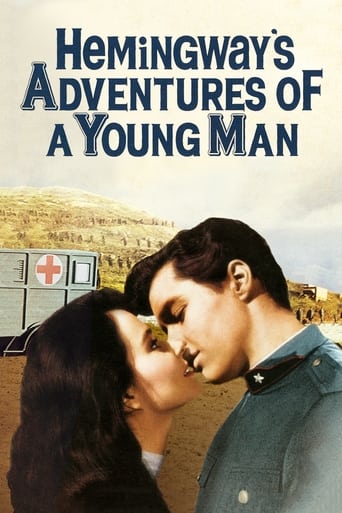
젊은이의 모헙 (1962)
Hemingway’s Adventures of a Young Man
오만한 어머니와 심약하지만 자존심 강한 의사 아버지 사이의 외동 아들 닉 애덤스. 늘 답답하고 불만스럽게 느껴지는 현실을 벗어나고자 닉은 그가 자란 시골 마을 미시간을 떠나 모험 가득한 대륙 횡단 여행을 하게 된다. 여행중 우연히 만난 펀치 드렁크로 고생을 하고 있는 전직 복서와 여행을 즐기는 알콜 중독자등이 그의 평범했었던 일상에 큰 영향을 주게된다. 뉴욕에서 직업을 구하기 위해 리포터로 활동을 하고 싶었지만 번번이 실패한 후 구급차 운전병으로 1차 세계 대전이 한창인 이태리 육군에 지원한다. 동료 병사와 우의를 다지고 새 생활을 열어 나가는 중에 부상을 입게 되고 간호사 아가씨와 사랑도 나누게 되는데...
- 개봉일
- 1962-07-25
- TMDB
- 5.6 / 10 (17)
- 상영 시간(분)
- 2시간 25분
- 장르
- 드라마, 로맨스
- 감독
- Martin Ritt
출연진
- 리처드 베이머 — Nick Adams
- Diane Baker — Carolyn
- Corinne Calvet — Contessa
- Fred Clark — Mr. Turner
- Dan Dailey — Billy Campbell
- James Dunn — Telegrapher
- Juano Hernandez — Bugs
- Arthur Kennedy — Dr. Henry Adams
- Ricardo Montalban — Major Padula
- 폴 뉴먼 — The Battler
- Susan Strasberg — Rosanna
- 제시카 탠디 — Mrs. Helen Adams
흥미로운 사실
Hemingway's Adventures of a Young Man is a 1962 American adventure drama film directed by Martin Ritt from a screenplay by A. E. Hotchner, based on Ernest Hemingway's semi-autobiographical character Nick Adams. It stars Richard Beymer as Adams, along with an ensemble cast that features Corinne Calvet, James Dunn, Arthur Kennedy, Ricardo Montalbán, Susan Strasberg, Jessica Tandy, Eli Wallach, Juano Hernandez and Paul Newman.
Production
A. E. Hotchner had adapted five Nick Adams stories for a program on The Seven Lively Arts called "The World of Nick Adams". Directed by Robert Mulligan it was well received, and admired by Hemingway.
Jerry Wald and Hochtner then approached Hemingway seeking the rights to either Across the River and Into the Trees or the Nick Adams stories. Hemingway did not want to sell rights to his novel and was only keen on selling one Nick Adams story. Hotchner pitched to buy the rights for 10 of the 19 stories.
The stories used in th first part of the movie wer "Indian Camp", "The Doctor and the Doctor's Wife", "The End of Something", and "The Three-Day Blow". The stories used in the second part were "The Battler" and "A Pursuit Race" (the second part) and "A Very Short Story". The third and final section of the movie used "In Another Country", "Now I Lay Me", and "A Way You'll Never Be" (Nick in the Italian army).
The stories are connected only by the fact that Nick appears in all of them; other than that, they are isolated experiences of fear, disillusionment, courage, love, war, and loneliness. Each one is a glistening shaft sticking in the heart of an emotional experience. But to fuse them and embellish them for the screen without disturbing their impact was a particularly difficult assignment.
Hotchner started writing the script in December 1960. The rights were reportedly $300,000.
위키백과에서 더 읽기 · 텍스트 출처: 위키백과, CC BY-SA 4.0. 데이터 출처: Wikidata.
추천
- 시크릿 더 무비 - 간절히 꿈꾸면 2020 · ★ 7.4
- 봄날은 간다 2001 · ★ 7.0
- Flamingo Road 1949 · ★ 7.0
- 러블리, 스틸 2009 · ★ 6.6
- 너의 결혼식 2018 · ★ 7.6
- 백만장자의 첫사랑 2006 · ★ 7.3
- 더 매직 오브 오드너리 데이즈 2005 · ★ 7.6
- 살로메 1953 · ★ 5.8
- 동감 2022 · ★ 6.9
- Strangers When We Meet 1960 · ★ 6.4
- The Lost Husband 2020 · ★ 6.6
- 순정 2016 · ★ 7.9