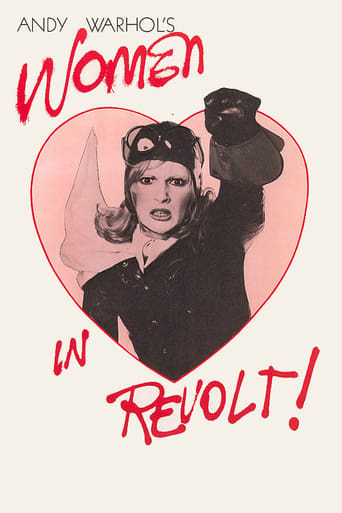
Women in Revolt (1971)
The Beginning of the Sexual Revolution!
Candy is an aloof heiress caught in an unhappy relationship with her brother. Jackie is a virginal intellectual who believes women are oppressed in contemporary American society. And Holly is a nymphomaniac who has come to loathe men, despite her attraction to them. Together, they join a militant feminist group, P.I.G. (Politically Involved Girls), but their newfound liberation doesn't make them any happier.
- Date of release
- 1971-12-01
- TMDB
- 5.0 / 10 (14)
- Runtime
- 1h 37m
- Genres
- Drama, Comedy
- Director
- Paul Morrissey
Casting
- Holly Woodlawn — Holly
- Candy Darling — Candy
- Jackie Curtis — Jackie
- Johnny Kemper — Johnny Minute
- Geri Miller — Girl in Bar
- Jonathan Kramer — Journalist
- Michael Sklar — Max Morris
- Maurice Braddell — Candy's Father
- Martin Kove — Marty
- Paul Kilb
- Duncan MacKenzie — Duncan
- Dusty Springs — Dusty
Interesting facts
Women in Revolt is a 1971 American comedy-drama film directed by Paul Morrissey and produced by Andy Warhol. Starring Warhol superstars Candy Darling, Jackie Curtis, and Holly Woodlawn, the film satirizes the women's liberation movement through the story of three women who form a radical feminist group called P.I.G.. Released in the aftermath of the 1968 shooting of Warhol, Women in Revolt has been interpreted as a response to radical feminism and the SCUM Manifesto by Valerie Solanas. The film features soundtrack music by John Cale.
Production
Filming began in spring 1970 and took about a year to complete. Morrissey later claimed sole responsibility for Women in Revolt, declaring " "I did everything": producing, casting, editing, directing, and cinematography. Not only had Andy done nothing—since Andy had no ideas—Andy wasn't even on the set." However, there are photographs of Warhol on set, and George Abagnalo, who worked at the Factory and appeared in the final scene, recalled that t…
Morrissey likely directed most of the film, although Jackie Curtis refused to perform for him, saying he "only makes Joe [Dallesandro] look good. Warhol and his boyfriend Jed Johnson are credited as cinematographers. Curtis recalled: "My big scene was when I was painting my toenails, and Paul Morrissey wanted that scene out, but I wanted it, and Andy said, 'I want the scene in.'" Curtis added, "I told Andy that I'd be in it only if he'd be behind…
Morrissey himself gave earlier accounts crediting Warhol with the film's conception. In an unpublished interview, he said Warhol "thought up the idea of using Holly and Candy and Jackie as Women's Lib." He similarly told biographer Victor Bockris that he initially viewed the project as a deliberate challenge by Warhol, prompted in part by Valerie Solanas's association with the women's movement, but supported it once he realized Warhol was committ…
Although Morrissey received screenwriting credit, Johnson stated in a 1970 interview with After Dark that the dialogue was largely improvised: "A lot of people ask if we have a working script on our movies because the dialogue is so clever … what happens, as usual, is that Paul Morrissey gives a sentence to the actors and has them improvising on a topic while the camera is rolling."
Working titles for the film included P.I.G.S. ("Politically Involved GirlS"), Blonde on a Bum Trip, and Sex—possibly a reference to actress Mae West's 1926 play Sex.
Read on Wikipedia · Text from Wikipedia, CC BY-SA 4.0. Data from Wikidata.
Recommended
- Treasure 2024 · ★ 6.4
- Almost Friends 2017 · ★ 6.3
- The House of Tomorrow 2019 · ★ 6.8
- Juniper 2021 · ★ 6.5
- Tyler Perry's Madea on the Run - The Play 2017 · ★ 7.5
- Uncorked 2020 · ★ 6.1
- Fat Kid Rules The World 2012 · ★ 6.7
- Hooking Up 2020 · ★ 6.3
- ¿Y cómo es él? 2022 · ★ 7.5
- Match 2014 · ★ 5.8
- CQ 2001 · ★ 5.9
- Landline 2017 · ★ 6.2